
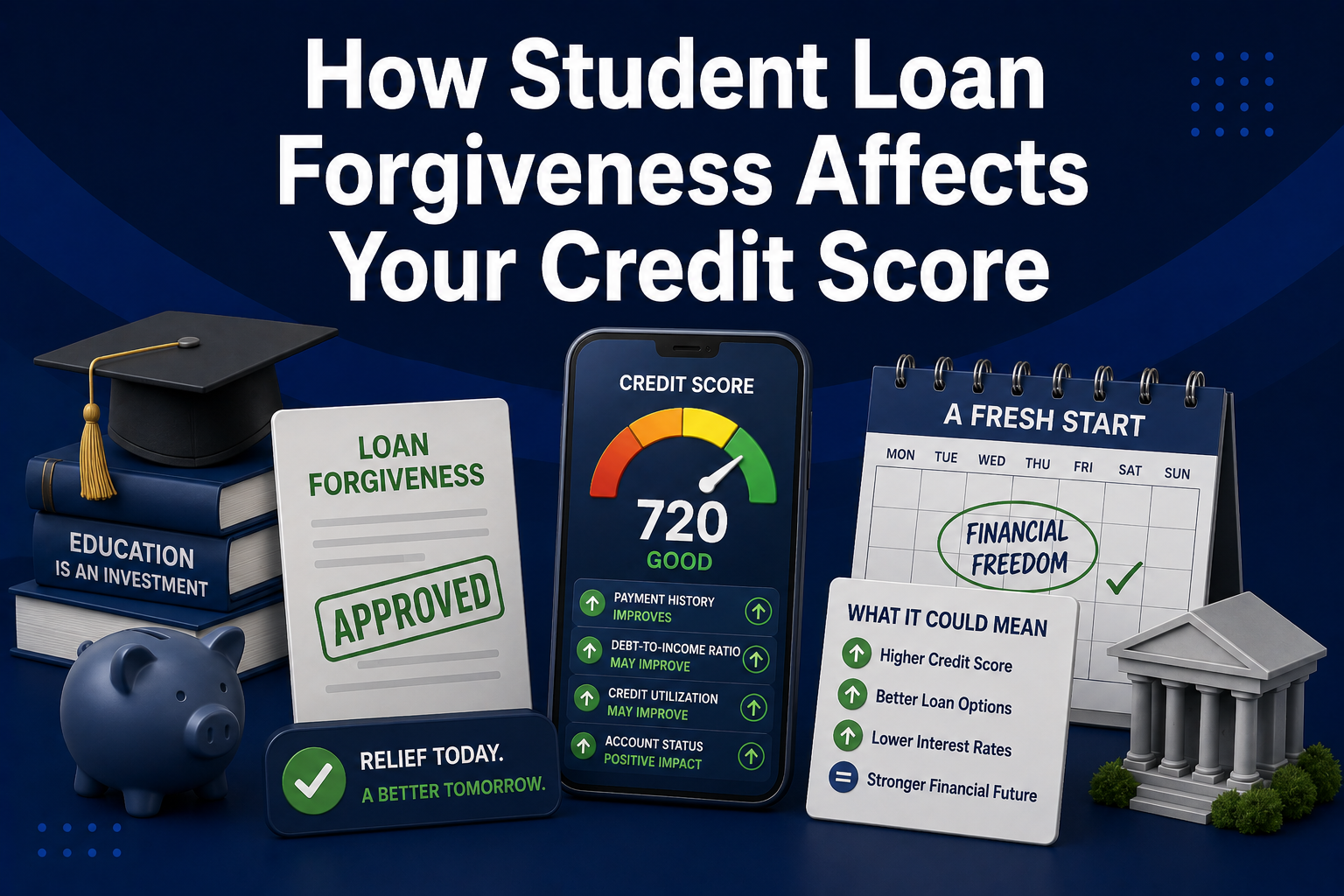
Student loan forgiveness sounds like an unambiguous win. Your debt is wiped out and you never have to pay it back. But when it comes to your credit score, the reality is more nuanced. Loan forgiveness can affect your credit in ways that are positive, neutral, or occasionally temporarily negative depending on how your loans were structured and what your credit file looks like before forgiveness.
Here is a clear breakdown of what actually happens to your credit when student loans are forgiven.
The good news first
For most borrowers, student loan forgiveness is either neutral or mildly positive for their credit score. The forgiven loan shows up on your credit report as paid in full or closed with a zero balance. A loan that is paid in full is a positive credit event, and it removes what may have been a significant balance from your total debt load.
If your forgiven loans had been in good standing throughout repayment, the account history, including all those years of on-time payments, remains on your credit report for up to ten years after the account closes. That positive payment history continues to benefit your score for years after the loan is gone.
The potential temporary downside
The reason some borrowers see a temporary score dip after loan forgiveness comes down to two factors: credit mix and account age.
Having a mix of revolving accounts like credit cards and installment accounts like loans contributes positively to credit mix, which accounts for 10% of your FICO score. When an installment account is closed, your mix becomes less diverse. If student loans were your only installment accounts, their forgiveness and closure can slightly reduce this factor.
Average account age. The length of your credit history accounts for 15% of your score, including the average age of all open accounts. When a long-standing loan account closes, it no longer contributes to your average account age calculation for open accounts. If your student loans were among your oldest accounts, their closure can lower your average account age slightly.
Both of these effects tend to be modest, often just a few points, and temporary. The closed account remains on your report for up to ten years and its positive history continues to count during that time.
What about debt-to-income ratio?
Debt-to-income ratio does not appear on your credit report and is not a factor in your credit score. However, it matters significantly to lenders when you apply for mortgages and other major loans. Having student loan debt forgiven reduces your monthly debt obligations and therefore improves your DTI.
This can be a significant benefit if you were previously unable to qualify for a mortgage because your student loan payments were pushing your DTI above lender thresholds. Forgiveness may open the door to homeownership that the debt was blocking.
What about loans that were in default before forgiveness?
This is where it gets more complicated. If your student loans were in default before being forgiven, the negative marks associated with that default, including late payment records and the default notation itself, do not automatically disappear when the loan is forgiven.
A loan forgiven through Public Service Loan Forgiveness or income-driven repayment forgiveness programs, where the borrower was in good standing throughout, closes as paid in full with no negative history attached. A loan forgiven after a period of default may still carry the derogatory marks from that period on the credit report, even though the balance is now zero.
If your loans had negative marks before forgiveness and those marks are still showing on your report, you can dispute any inaccuracies but accurately reported derogatory information from a default period remains on your report for seven years from the original delinquency date regardless of forgiveness.
The income tax question
This is not a credit question but it is an important one. Depending on the type of forgiveness and current tax law, forgiven student loan balances may be treated as taxable income in the year of forgiveness. This does not affect your credit score but it can affect your financial situation in that year.
Federal student loan forgiveness under income-driven repayment plans was tax-free through 2025 under temporary provisions. The tax treatment beyond that period depends on legislation in effect at the time of forgiveness. If you are approaching forgiveness, it is worth understanding the potential tax implications in advance.
How to protect your credit around loan forgiveness
In the months leading up to expected loan forgiveness, avoid opening new credit accounts that would lower your average account age further. If you have other installment accounts in good standing, maintain them to preserve your credit mix.
After forgiveness, monitor your credit file closely to make sure the loan is reported correctly as paid in full or closed with zero balance. If anything is reported inaccurately, dispute it promptly.
If the closure of your student loans reduces your credit mix and you want to add a new installment account to maintain diversity, a credit builder loan is a low-risk option. It adds an installment account without taking on significant debt.
And if you are a renter, this is a good moment to ensure your rent payments are being reported to the credit bureaus through a service like Credit Genius. Adding verified rent payment history to your Experian file provides ongoing positive payment data that supports your score as your credit profile adjusts to the closure of your student loans.
The bottom line
Student loan forgiveness is generally neutral to mildly positive for your credit score when the loans were in good standing. You may see a small temporary dip from credit mix and account age effects, but the positive payment history from years of on-time payments remains on your report and continues to benefit you.The financial benefit of eliminating the debt and improving your debt-to-income ratio almost always outweighs any minor credit score adjustment. For most borrowers, forgiveness is unambiguously good news, credit included.