
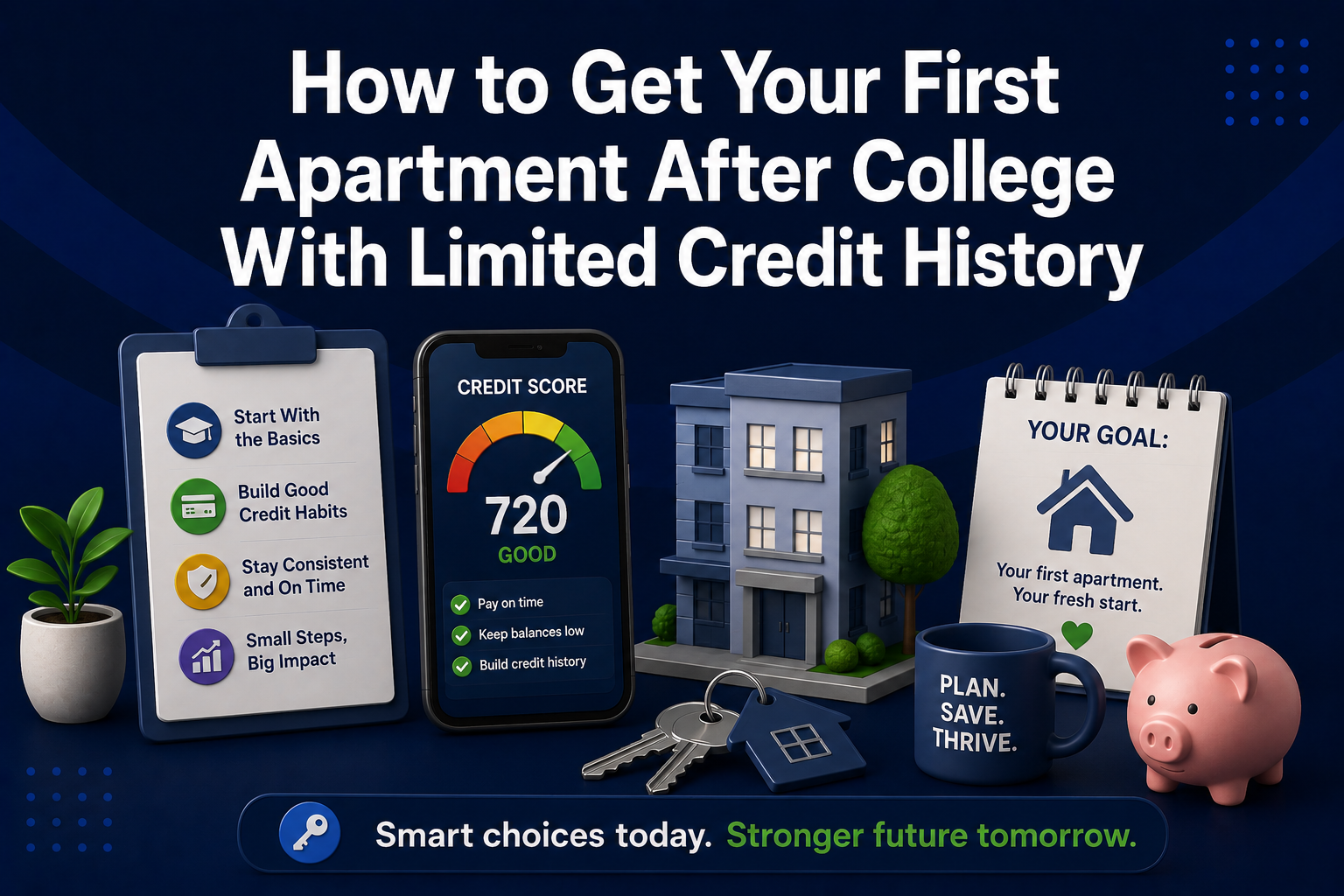
Getting your first apartment after college puts you in a frustrating position. Landlords want to see credit history to prove you are a reliable tenant. But you have spent the last four years living in dorms or student housing that did not require a credit check or build any credit history. The system expects experience you were never given the chance to build.
This is a solvable problem. Here is a practical guide to getting approved for your first apartment even with limited or no credit history.
Understand what landlords are actually evaluating
Landlords are not just looking at a credit score number. They are trying to answer one question: will this person pay rent on time every month? Your credit score is one input into that question but it is not the only one. Income, references, rental history, and the overall picture of your application all factor in.
This matters because it means a thin credit file is not automatically a dealbreaker. It means you need to build a compelling case through other parts of your application that compensates for what the credit file cannot yet show.
Know your credit situation before you apply
Pull your credit reports from annualcreditreport.com before you start applying. You may have more credit history than you think. Student loans appear on your credit file. If you were added as an authorized user on a parent’s credit card at some point, that account history may appear on your report. If you had a credit card in college, that history is there.
Knowing exactly what is in your file lets you speak to it confidently in conversations with landlords and avoid surprises when they run a check.
Prove income clearly and compellingly
Most landlords want to see monthly income of at least two to three times the rent. If you have a job offer or have already started working, your offer letter, first pay stub, or employment verification letter is powerful documentation. If you are freelancing or starting a business, bank statements showing regular income deposits can supplement.
If your income meets the threshold clearly, many landlords are willing to look past a thin credit file. Lead with the income documentation rather than waiting for them to ask.
Get a co-signer
A co-signer with strong credit agrees to be legally responsible for the rent if you fail to pay. For a landlord worried about a thin credit file, a co-signer eliminates the risk they are concerned about. Most landlords will approve an applicant with limited credit if the co-signer has a strong profile.
This is a significant ask of the co-signer, typically a parent or close family member, because they are taking on real legal and financial exposure. Have an honest conversation about what you are asking them to do before making the request.
Offer a larger security deposit
A larger upfront deposit directly addresses the risk a landlord is concerned about. If you can offer two or three months of rent as a security deposit instead of one, many landlords will approve an application that might otherwise give them pause.
This requires having the cash available, which not everyone does immediately after college. If you have some savings from a summer job or a signing bonus from a new employer, allocating a portion to a larger deposit can be the difference between getting the apartment and not.
Provide strong references
A reference letter from a previous landlord, even a dorm RA, resident advisor, or university housing office, confirming that you paid on time and took care of your space carries real weight. If you lived off campus at any point, a reference from that landlord is even more valuable.
Personal references from employers, professors, or mentors who can speak to your reliability and character are also useful. A well-rounded application with strong references humanizes what a credit report cannot yet show.
Consider different types of landlords
Large corporate property management companies tend to have stricter, more standardized credit requirements with less flexibility for individual circumstances. Independent landlords renting one or a few units are often more willing to consider the full picture of an applicant rather than applying a hard cutoff score.
This does not mean avoiding large buildings, but it does mean that a direct conversation with a smaller landlord about your situation may be more productive than an online application to a large complex with automated screening.
Start building credit before you apply
If you have any lead time before your apartment search, use it. Even two to three months of credit building can make a meaningful difference.
If you have student loans, they are likely already on your credit file. Make your payments on time from the first payment due. Open a secured credit card and use it for one small purchase per month, paying the full balance each time. If you have a parent willing to add you as an authorized user on a long-standing account, that can immediately give your file more substance.
And once you are in your first apartment, enroll in rent reporting through Credit Genius immediately. That monthly rent payment is the largest financial obligation most people your age have. Getting it on your credit file from day one means you start building a real credit history from the moment you move in rather than losing months of positive data.
The bottom line
Getting your first apartment after college with limited credit is harder than it should be but it is absolutely achievable. Know your credit situation, lead with strong income documentation, consider a co-signer or larger deposit, choose the right type of landlord, and build as much credit as you can in the time available before you apply.Once you are in, report your rent from day one. The credit history you build in your first apartment sets the foundation for every housing application, loan, and financial decision that follows.