
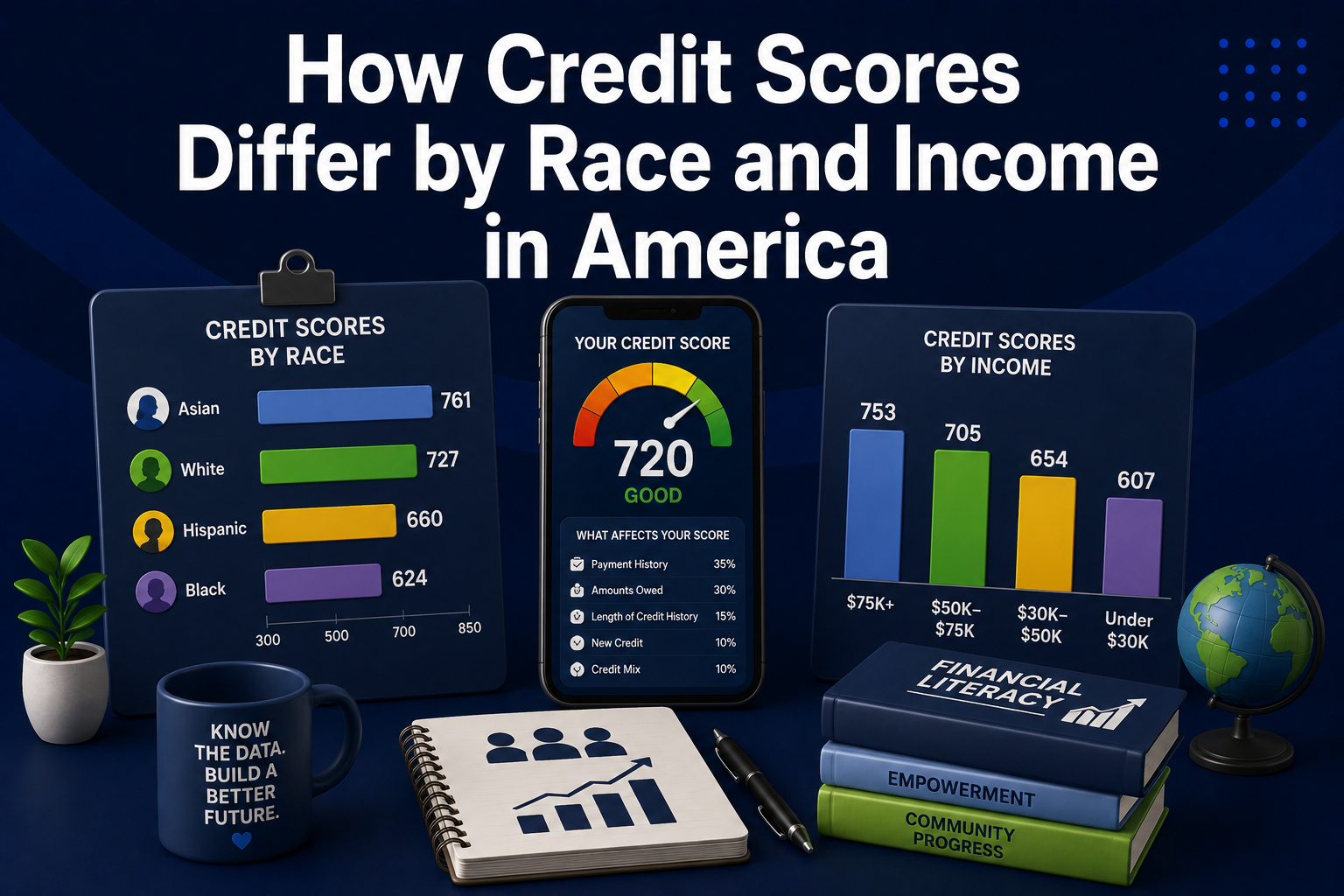
Credit scores are presented as objective measures of individual financial behavior. In practice, the data shows persistent and significant gaps in credit scores across racial and income lines. Understanding those gaps, where they come from, and what they mean for the people affected by them is important context for anyone trying to build or improve their credit in America.
This article covers what the data actually shows, the structural reasons behind it, and what individuals can do to build credit despite systemic disadvantages.
What the data shows
The credit score gaps between racial groups in the United States are well documented. Research from the Urban Institute and other policy organizations consistently finds that Black and Hispanic Americans have significantly lower average credit scores than white and Asian Americans. A 2022 analysis found that the average credit score for Black Americans was approximately 100 points lower than for white Americans.
Income correlates with credit scores as well, though the relationship is more nuanced than it might appear. Higher income households tend to have higher average credit scores, but the correlation is not one-to-one. Lower income households are more likely to be credit invisible, meaning they have no credit file at all, or to have thin files with limited history.
The Consumer Financial Protection Bureau has estimated that approximately 26 million Americans are credit invisible and another 19 million have files too thin or stale to generate a reliable score. These populations are disproportionately Black, Hispanic, and lower income.
Why these gaps exist: the structural factors
The credit score gaps between racial and income groups did not emerge from individual behavior alone. They are the product of structural factors that have shaped access to credit building opportunities across generations.
Historical exclusion from credit. Redlining, discriminatory lending practices, and explicit exclusion of Black Americans from FHA-backed mortgages and conventional credit products through much of the twentieth century meant that generations of Black families were prevented from building the credit history and home equity that wealth and credit scores are built on. These exclusions were not individual failures. They were policy.
The homeownership gap. Mortgage payments are automatically reported to the credit bureaus and contribute directly to credit scores. Homeownership rates among Black Americans are significantly lower than among white Americans, a gap that traces directly to historical exclusion and continues to compound. Renters, who are disproportionately Black and Hispanic, make their largest monthly payment without receiving credit recognition for it unless they actively report it.
Lower income creates direct credit challenges: higher likelihood of carrying high utilization, greater vulnerability to missed payments during financial shocks, and less ability to maintain the savings buffer that protects credit during emergencies. The racial wealth gap, estimated at roughly ten to one between white and Black households by the Federal Reserve, means these income-related credit challenges fall disproportionately on communities of color.
Predatory lending. Communities of color have been disproportionately targeted by high-interest payday lenders, predatory auto dealers, and subprime mortgage products. These products often create credit damage rather than building credit, leaving borrowers with derogatory marks from products that were designed to extract rather than support.
Credit invisibility. Communities with lower homeownership rates, less access to mainstream banking, and less generational wealth to pass on credit-building knowledge and authorized user access are more likely to be credit invisible. Credit invisibility is not a reflection of financial irresponsibility. It is a reflection of which financial behaviors the credit system was designed to recognize.
Does the credit scoring system itself contribute to the gaps?
This is a legitimately debated question among researchers and policy advocates. The credit scoring system does not use race as a factor and is prohibited from doing so. But critics argue that factors like the exclusion of rent and utility payments from traditional scoring, the emphasis on account age which disadvantages those who were historically excluded from credit, and the reliance on data from a system that has historically underserved communities of color means the system encodes historical inequity even without explicitly using race.
Defenders of the current system argue that credit scores are accurate predictors of repayment behavior across all demographic groups and that the solution to the gap is expanding access to credit rather than changing the scoring methodology.
Both arguments contain truth. The gaps in credit scores reflect real differences in credit behavior that are themselves produced by structural inequity. Addressing the gaps requires both expanding what counts as credit-worthy behavior and addressing the underlying conditions that create unequal credit outcomes.
What is being done to address the gaps
Several policy and industry developments in recent years are directly aimed at reducing credit score disparities.
The expansion of rent reporting is one of the most significant. Legislation in several states now requires landlords to offer rent reporting to tenants. The CFPB has encouraged broader use of alternative data including rent and utility payments in credit underwriting. Companies like Credit Genius that report rent to Experian are part of an industry-wide movement to make the credit system recognize the financial behaviors of renters, who are disproportionately people of color.
The removal of medical debt from credit reports, completed for collections under 500 dollars in 2023 and expanded further, disproportionately benefits communities of color who are more likely to carry medical debt due to lower rates of insurance coverage.
Alternative credit scoring models that incorporate rent, utility, and other non-traditional payment data are gaining traction among some lenders, particularly for mortgage underwriting.
What individuals can do
Structural problems require structural solutions and individual action alone cannot close gaps that were produced by decades of policy. But understanding the system and using the tools available to work within it remains the most practical path forward for individuals navigating it right now.
Report your rent. If you are paying rent on time, that payment should be on your credit file. Credit Genius reports to Experian with backdating, giving you credit for the financial behavior you are already demonstrating.
Dispute errors. Research suggests that errors in credit reporting may disproportionately affect communities of color. Pull all three reports and dispute anything inaccurate.
Access credit-building tools designed for thin file borrowers. Secured cards, credit builder loans, and rent reporting services are all accessible without existing credit history.
Use personalized guidance. Generic credit advice does not account for the specific factors affecting individual credit files. AI-powered tools like the Credit Genius credit assistant analyze your actual file and tell you which actions will have the most impact for your specific situation.
The bottom line
Credit score gaps by race and income in America are real, significant, and rooted in structural factors that go well beyond individual financial behavior. Understanding those factors matters for policy, for product design, and for individuals trying to navigate a system that was not built with equal access in mind.The credit system is imperfect and unequal in its current form. But it is also the system that determines access to housing, cars, loans, and financial opportunity for most Americans. Working within it effectively while advocating for its reform is not a contradiction. It is a practical necessity.