
Most Americans do not know that their credit score affects how much they pay for car insurance. In the majority of US states, insurance companies use a credit-based insurance score, which is derived from credit report data, to help set premiums. Drivers with lower credit scores often pay significantly more for the same coverage than drivers with excellent credit, regardless of their actual driving record.
But not everywhere. A handful of states have banned or significantly restricted the use of credit in insurance pricing. Here is what you need to know about which states those are, why the practice exists, and what it means for your wallet.
What is credit based insurance scoring?
A credit-based insurance score is not the same as your FICO credit score. It is a separate score calculated from similar credit report data, including payment history, outstanding debt, credit history length, and types of credit, but weighted differently to predict the likelihood of filing an insurance claim rather than defaulting on a loan.
Insurance companies and researchers have found a statistical correlation between credit behavior and insurance claim frequency. People with lower credit-based insurance scores file more claims on average than people with higher scores. Insurers use this correlation to price risk, resulting in higher premiums for policyholders with poor credit even if they have never filed a claim.
Critics argue that this correlation reflects socioeconomic factors rather than individual risk, and that using credit data in insurance pricing disproportionately harms lower-income communities and communities of color who tend to have lower credit scores for structural reasons unrelated to their actual insurance risk.
States that ban credit based insurance scoring
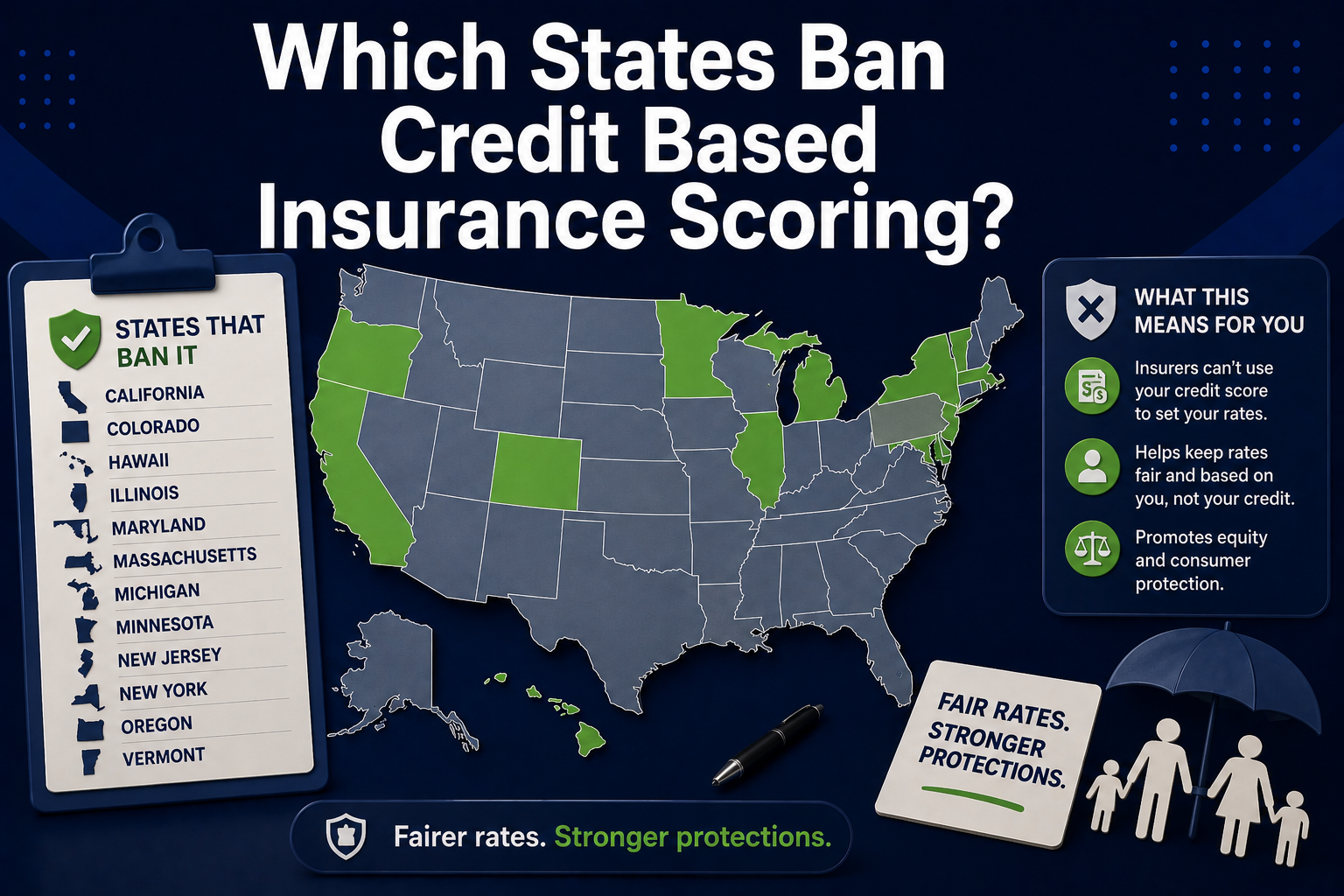
Three states currently ban the use of credit information in auto insurance pricing entirely: California, Hawaii, and Massachusetts. These states prohibit insurers from using credit scores or credit-based insurance scores as a factor in setting premiums, determining eligibility, or renewing policies.
In these states, your credit score has no bearing on your auto insurance premium. Rates are set based on other factors including driving record, vehicle type, age, location, and annual mileage.
Michigan also has restrictions on the use of credit in insurance pricing, though the rules are more nuanced and have evolved through legislative changes in recent years.
For homeowners insurance, the picture is similar. California, Maryland, and a few other states have restrictions or bans on using credit in homeowners insurance pricing, though the specifics vary by state and by the type of restriction in place.
What about the other 47 states?
In the majority of US states, credit-based insurance scoring is permitted and widely used. The financial impact can be significant. According to research by the Consumer Federation of America, drivers with poor credit can pay 50 to 100% more for auto insurance than drivers with excellent credit for identical coverage in the same location.
On a 1,500 dollar annual auto insurance premium, that represents an additional 750 to 1,500 dollars per year purely from the credit score factor. Over five years, that is 3,750 to 7,500 dollars in additional premium costs attributable to credit alone.
The impact on homeowners insurance varies by insurer and state but can also be significant. Some studies have found premium differences of 20 to 50% or more between policyholders with excellent and poor credit in states where credit scoring is permitted.
Legislative trends
The COVID-19 pandemic sparked renewed scrutiny of credit-based insurance scoring after research showed that communities hardest hit economically by the pandemic, many of which were communities of color, would face insurance premium increases tied to credit score declines caused by the pandemic rather than by any change in their actual risk profile.
Several states considered or passed temporary restrictions on using pandemic-related credit changes in insurance pricing. The broader debate over whether credit-based insurance scoring should be restricted or banned entirely has continued in state legislatures across the country, with consumer advocates pushing for expansion of the California, Hawaii, and Massachusetts model.
The regulatory landscape in this area is evolving. Consumers in states currently permitting credit-based insurance scoring should monitor legislative developments that could affect their premiums.
What you can do if you live in a state that allows credit based insurance scoring
The most direct action available is improving your credit score, which improves your credit-based insurance score along with it. The same behaviors that build a strong FICO score, paying on time, keeping utilization low, and maintaining a clean credit history, also improve the credit-based insurance score insurers use.
When your credit score improves meaningfully, ask your insurer to re-run your credit-based insurance score. Many insurers will do this at renewal or upon request. A significant improvement in your credit profile can result in a lower premium without changing your coverage.
Shopping your insurance policy when your credit has improved is also worthwhile. Different insurers weight credit differently in their scoring models. Getting quotes from multiple insurers after a credit improvement can surface premium differences of hundreds of dollars per year.
Tools like Credit Genius that provide real-time Experian monitoring and personalized guidance on the actions most likely to improve your score help you work toward the credit improvements that reduce costs across multiple financial products simultaneously, including insurance premiums in states where credit scoring is permitted.
The bottom line
Credit-based insurance scoring is banned in California, Hawaii, and Massachusetts for auto insurance and restricted in a few additional states. In the remaining states, your credit score affects what you pay for insurance and the financial impact can be substantial.
If you live in a state where credit scoring is permitted, improving your credit score reduces your insurance costs alongside every other financial benefit a stronger score provides. The insurance premium reduction is one more reason why credit building pays off in real, measurable dollars.