
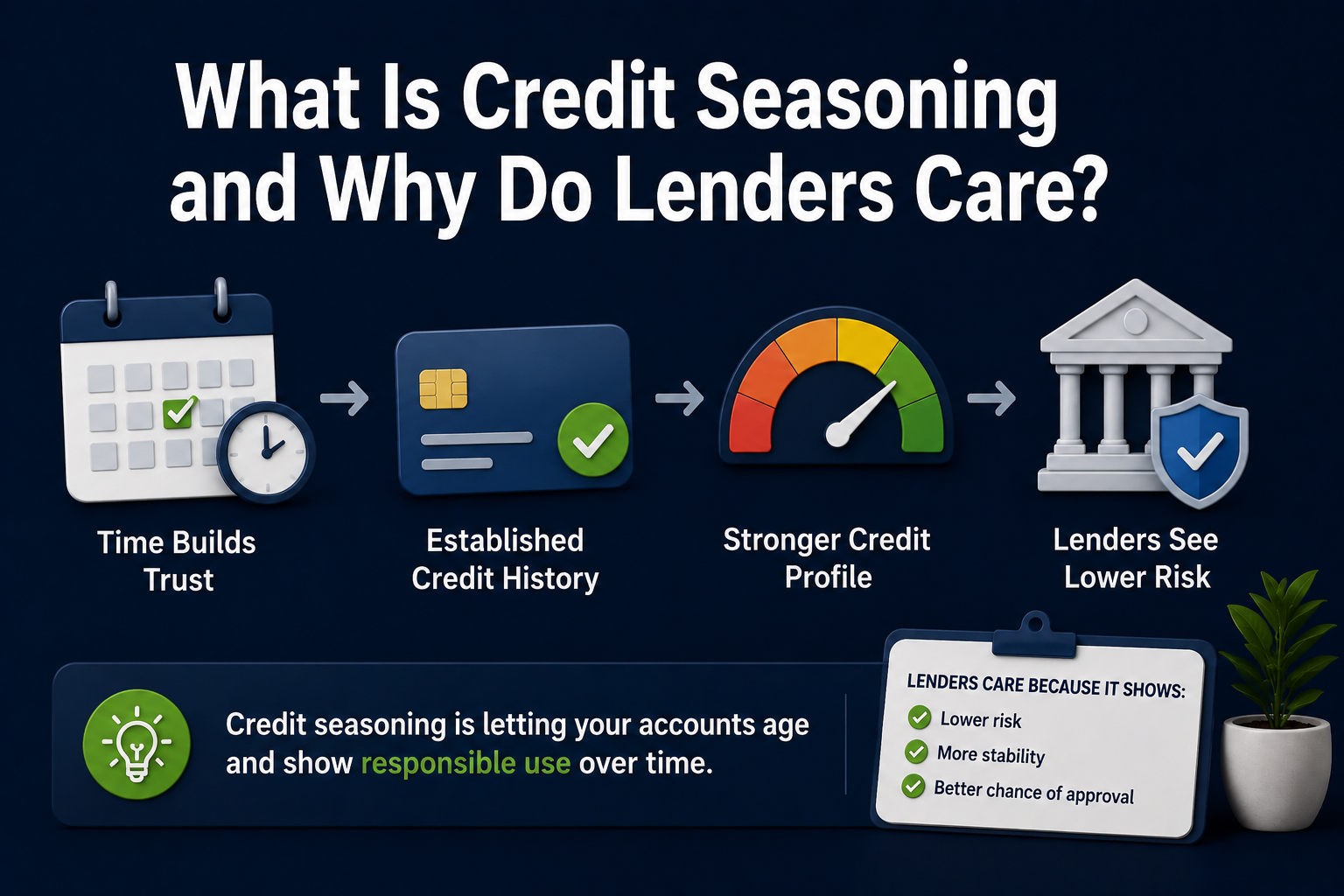
If you have ever applied for a mortgage or a significant loan and been told your credit history is too new or that you need more seasoned accounts, you have encountered the concept of credit seasoning without necessarily being told what it means. It is a term used by lenders and credit professionals that most consumers have never heard, yet it affects loan approvals and interest rates in real ways.
Here is a clear explanation of what credit seasoning is, why lenders care about it, and what you can do to build it.
What credit seasoning means
Credit seasoning refers to the age and established history of credit accounts on your credit report. A seasoned account is one that has been open for a meaningful period of time, typically at least twelve to twenty-four months, and has a demonstrated track record of on-time payments during that period.
The term comes from the idea that like seasoned wood or seasoned cast iron, a credit account becomes more valuable with age and use. A brand new account tells a lender very little about how you will manage it long-term. An account with three years of consistent payment history tells a much more complete story.
Credit seasoning applies to individual accounts as well as to your credit file overall. A lender might look at the age of your oldest account, your newest account, and the average age of all accounts when evaluating your application.
Why lenders care about seasoning
Lenders use credit history as a predictor of future behavior. The core question they are trying to answer is: based on what this person has done with credit in the past, how likely are they to repay this loan on time?
A credit file full of new accounts opened in the last six months provides limited predictive information. The accounts have not had time to demonstrate how they will be managed through different financial circumstances. A credit file with accounts that have been consistently managed for three, five, or ten years provides much stronger evidence of reliable credit behavior.
This is particularly true for mortgage lending. Mortgage lenders are evaluating your ability to make consistent payments over fifteen or thirty years. They want to see evidence that you have managed credit responsibly over a meaningful period, not just that you opened several accounts recently.
How seasoning affects your credit score
Length of credit history accounts for 15% of your FICO score. This factor includes the age of your oldest account, the age of your newest account, and the average age of all accounts. The longer these ages, the better this factor contributes to your score.
This is why opening multiple new accounts in a short period can temporarily lower your score. Each new account is unseasoned, it pulls down your average account age and your newest account age. The impact is temporary because the accounts gain age over time, but it is real in the short term.
It is also why closing old accounts is generally a bad idea from a credit perspective. A ten-year-old account that you close removes valuable seasoning from your file. Even if you stop using the card, keeping it open preserves that account age.
Minimum seasoning requirements in mortgage lending
Mortgage lenders often have explicit seasoning requirements that go beyond credit score thresholds. These are minimum periods of time that must have passed since certain credit events before an applicant can qualify.
After bankruptcy: Most conventional loan programs require two to four years of seasoning after a Chapter 7 bankruptcy discharge before an applicant qualifies. FHA loans require two years. VA loans may be as short as two years depending on the lender.
After foreclosure: Conventional loans typically require seven years of seasoning after a foreclosure. FHA loans require three years. VA loans require two years.
After short sale: Conventional loans generally require four years of seasoning after a short sale. FHA loans require three years.
These waiting periods exist because lenders want to see evidence of financial rehabilitation after a serious credit event before extending a large, long-term loan.
How to build seasoning faster
The frustrating reality of credit seasoning is that time is the primary variable. You cannot manufacture seasoning the way you can reduce utilization or dispute errors. Accounts simply need to age.
That said, there are strategies that help. Becoming an authorized user on a long-standing account with good history can add seasoning to your file immediately. If a family member adds you to an account they have had for eight years, that account’s history can appear on your report and contribute to your average account age.
Rent reporting with backdating is another way to add historical payment data to your file quickly. When Credit Genius reports rent payment history to Experian with backdating of up to 24 months, it adds two years of established payment history to your file. While this affects payment history rather than account age specifically, it contributes to the overall picture of an established, reliable credit profile that lenders associate with seasoning.
Opening accounts earlier rather than later is the most fundamental strategy. Every month you delay starting to build credit is a month of seasoning you cannot recover. For young people especially, opening a first credit account at 18 or 19 rather than 25 means six or seven additional years of credit history by the time major financial decisions arrive.
What not to do
Do not close old accounts in an attempt to simplify your credit profile. Closing old accounts removes seasoning from your file and reduces your available credit. Both outcomes are negative.
Do not open multiple new accounts in a short period if you are approaching a major loan application. New accounts signal unseasoned credit and temporarily lower your average account age.
Do not confuse credit score with credit seasoning. A person can have a credit score in the 700s but still face seasoning-related questions from mortgage lenders if their accounts are all relatively new. Score and seasoning are related but separate considerations.
The bottom line
Credit seasoning is a dimension of your credit profile that rewards patience and early action. Start building credit as early as possible. Keep old accounts open. Avoid unnecessary new account applications that dilute your average account age. And use tools like rent reporting with backdating to add established payment history to your file when you can.The credit system rewards people who have been in it for a long time and managed it well. Understanding seasoning is understanding one more way that the system works and how to build a profile that satisfies the most thorough lender scrutiny.