
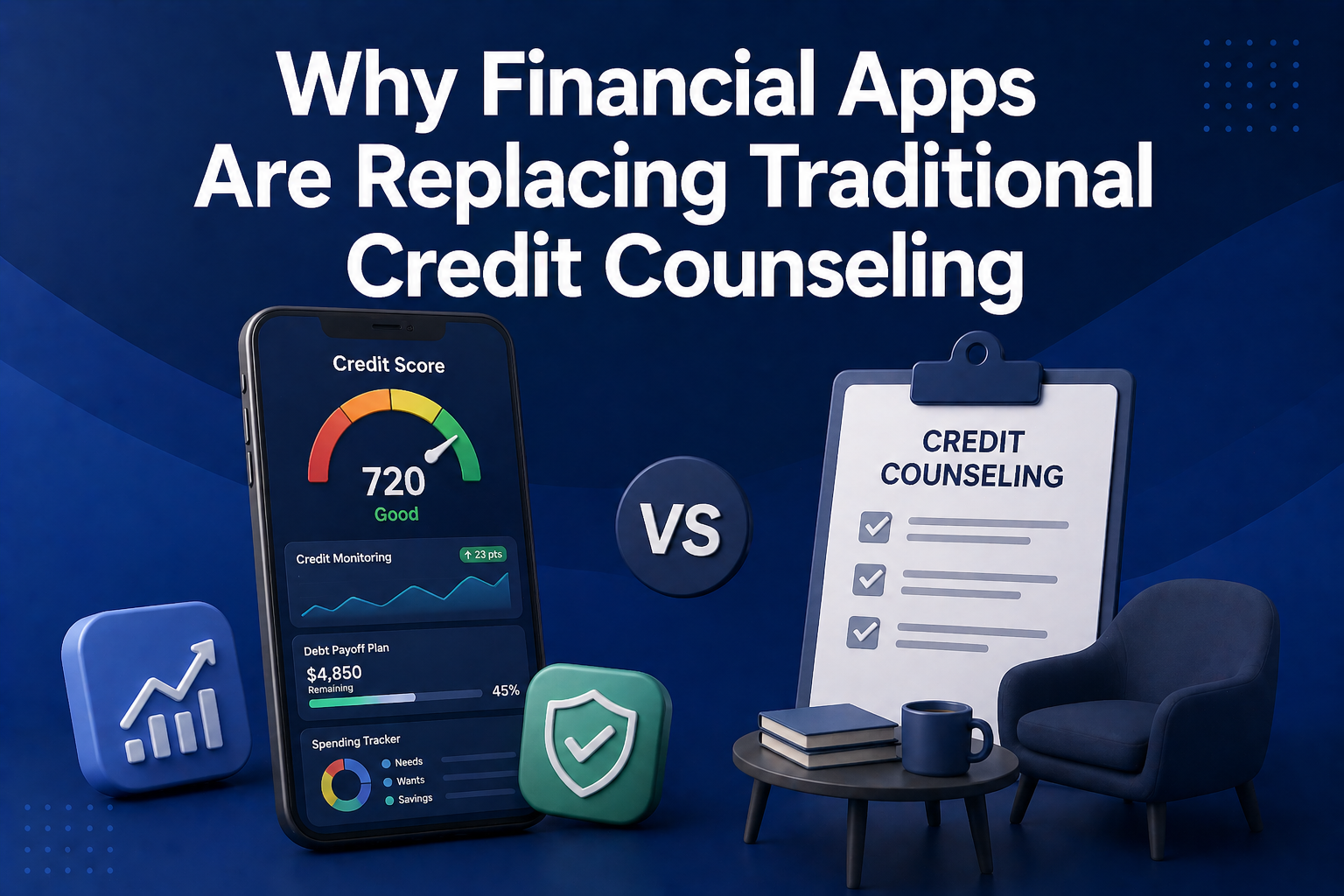
Traditional credit counseling has existed for decades as a way to help Americans manage debt and improve their financial standing. It works, for the people who access it. The problem is that most people never do. Scheduling an appointment, sitting across from a stranger to discuss financial problems, and navigating nonprofit or agency processes creates enough friction that the majority of people who need help simply do not seek it.
Financial apps are changing that, and the shift has accelerated significantly in the years leading up to 2026. Here is why it is happening and what it means for consumers.
The access problem with traditional counseling
Traditional credit counseling, whether through nonprofit agencies, HUD-approved housing counselors, or fee-based financial planners, has always had an access problem. It requires scheduling, it requires disclosure of sensitive financial information to another person, and in many cases it requires either time off work or navigating an appointment system that does not match the way most people manage their lives.
There is also a stigma dimension. Seeking credit counseling can feel like an admission of failure, which is enough to prevent many people from taking the step even when they clearly need it. The result is that the people most likely to benefit from financial guidance are the least likely to access traditional channels for it.
What financial apps do differently
Financial apps address the access problem by removing the friction entirely. The guidance is available at any time, in private, without requiring an appointment or a conversation with another person. For the majority of Americans who would benefit from financial guidance but will not walk into a counselor’s office, this changes everything.
The shift from generic to personalized advice is equally significant. Traditional credit counseling, particularly in group or workshop formats, delivers the same information to everyone. A person with a thin credit file who has never missed a payment receives the same guidance as someone with a history of collections and high debt. The advice is technically accurate for both but practically useful for neither in a targeted way.
AI-powered financial apps analyze your specific financial situation and deliver guidance that is calibrated to your actual circumstances. The credit advice you receive is not generic. It is based on what is actually in your credit file, what is holding your score back, and what actions will have the most impact given your specific starting point.
The role of AI in personalized financial guidance
The transition from rule-based financial apps to AI-powered platforms represents a meaningful change in what consumer financial guidance can deliver. Earlier apps could show you your score and provide generic tips. AI-powered platforms can analyze patterns in your credit behavior, identify the specific factors holding your score back, and prioritize recommendations in a way that reflects your individual situation.
Credit Genius is one example of this shift. Its AI credit assistant reads your actual Experian credit file and surfaces the specific actions most likely to improve your score, in order of impact. Rather than telling every user to pay on time and keep utilization low, it tells individual users which balance to pay down first, whether disputing a specific item is worth their time, and what the next highest-leverage action is given their current file.
This is meaningfully different from what a scheduled appointment with a credit counselor typically delivers, and it is available at any time without requiring the user to disclose their situation to another person.
Gamification and engagement
One of the persistent problems with financial education is that people do not engage with it consistently enough for it to change behavior. Reading an article about credit utilization once does not produce lasting behavioral change. Understanding why utilization matters, seeing how it applies to your specific accounts, and being reinforced for taking action on that understanding is what produces change.
Gamified financial education, where learning is structured around progress, rewards, challenges, and streaks, produces higher engagement and better retention than passive content consumption. Financial apps that incorporate gamification are addressing the engagement problem that has always limited the effectiveness of traditional financial education.
Credit Genius builds this into its platform through Credit Games, designed specifically around the insight that financial behavior change is a habit and engagement problem as much as it is a knowledge problem.
Where traditional counseling still has an edge
Financial apps do not replace traditional credit counseling for every situation. Complex debt management plans, bankruptcy counseling, housing counseling required for certain loan programs, and situations involving multiple creditors and legal considerations still benefit from human expertise and the kind of personalized interaction that an app cannot fully replicate.
For situations that require a debt management plan, negotiation with multiple creditors, or formal bankruptcy counseling, a nonprofit credit counseling agency or a consumer law attorney remains the right resource. The National Foundation for Credit Counseling offers free or low-cost services for these situations.
The distinction is between guidance and intervention. Financial apps are increasingly effective at delivering guidance. Complex intervention still benefits from human involvement.
What this means for consumers
The practical implication is that high-quality, personalized financial guidance is more accessible than it has ever been. You do not need an appointment, you do not need to disclose your situation to a stranger, and you do not need to fit your schedule around office hours.
If you have credit questions, credit problems, or simply want to optimize a credit profile that is already in decent shape, the quality of guidance available through AI-powered financial apps in 2026 is genuinely competitive with what you would receive from many traditional counseling services for everyday credit management situations.
The bottom line
Traditional credit counseling is not going away. But it is being supplemented and in many everyday use cases replaced by financial apps that are more accessible, more personalized, and more engaging than the alternatives that existed a decade ago.
The shift is good for consumers. More people are getting better financial guidance than at any point in history, and the barrier to accessing that guidance has never been lower. The question is no longer whether quality financial guidance is available. It is whether you are using it.