
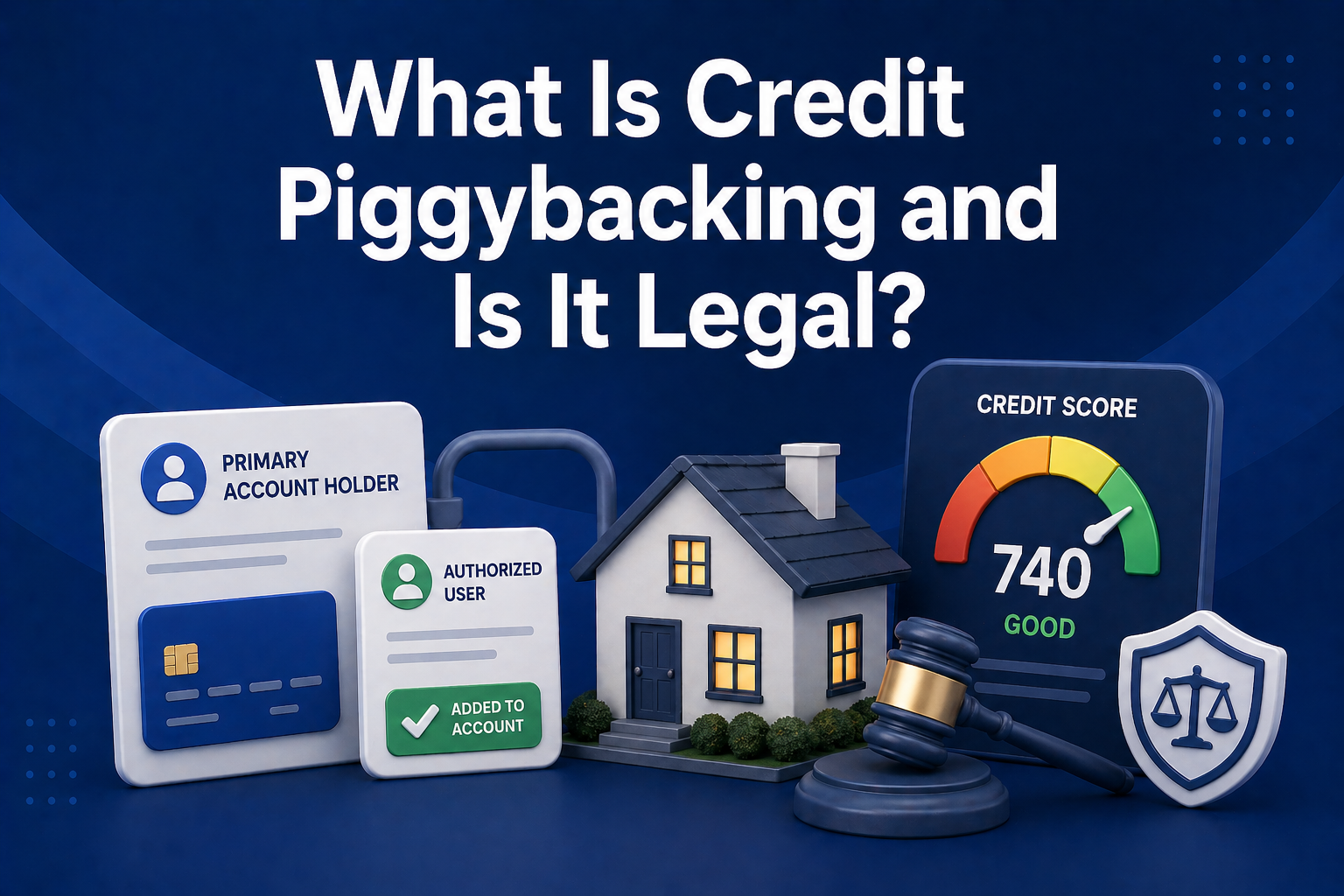
Credit piggybacking is a strategy where one person benefits from another person’s credit history by being added as an authorized user on their credit account. It is one of the fastest ways to add established credit history to a thin file, and it is a strategy that has been around for decades.
Whether it is legal, ethical, and practical depends significantly on how it is done. Here is everything you need to know.
How credit piggybacking works
When someone is added as an authorized user on a credit card account, the primary cardholder’s payment history and account age on that card can appear on the authorized user’s credit report. If the primary cardholder has a ten-year-old account with perfect payment history and low utilization, the authorized user potentially gains the benefit of that entire history the moment they are added.
This can have a significant impact on a thin credit file. A person with no credit history who is added as an authorized user on a long-standing account can go from unscorable to having a meaningful credit profile in a matter of weeks.
The authorized user does not need to use the card or even receive a physical copy. The benefit comes from the account appearing on their credit report, not from actual card usage.
The two types of credit piggybacking
This is the traditional version of the strategy and it is completely legal and widely used. A parent adds a child, a spouse adds a partner, or a friend with good credit adds someone they trust. The primary cardholder retains full control of the account. The authorized user benefits from the credit history.
This is a paid arrangement where a stranger with good credit allows someone they do not know to be added as an authorized user in exchange for a fee. Companies that facilitate these arrangements, sometimes called tradeline companies or seasoned tradeline services, charge consumers for access to established accounts.
Is credit piggybacking legal?
Family and friend piggybacking is legal. The authorized user concept is a standard feature of consumer credit accounts recognized by all major card issuers and credit bureaus. There is nothing legally problematic about a parent adding a child or a friend helping another friend.
Commercial piggybacking occupies a grayer area. It is not explicitly illegal in the United States, but it has attracted scrutiny from regulators and lenders. The Federal Reserve and FICO have both examined whether commercial tradeline arrangements constitute a form of credit fraud when the relationship between the primary cardholder and authorized user is purely financial.
FICO has periodically updated its scoring models, including FICO 8 and subsequent versions, with adjustments intended to limit the impact of authorized user accounts added purely for piggybacking purposes. The effectiveness of commercial piggybacking has diminished over time as a result.
More practically, if a lender discovers that a credit improvement was the result of commercial piggybacking rather than genuine credit development, it can affect their lending decision. Some lenders explicitly exclude authorized user accounts from their manual underwriting review.
The risks of commercial piggybacking
Beyond the legal gray area, commercial piggybacking carries practical risks. You are sharing personal information, including your Social Security Number, with a company and potentially with a stranger whose account you are being added to. Data security and privacy concerns are real.
The credit improvement from commercial piggybacking is also temporary in a way that organic credit building is not. When you are removed from the authorized user account, which can happen at any time, the credit benefit disappears. You have not built a credit history of your own. You have borrowed someone else’s temporarily.
For a mortgage application, lenders often look closely at authorized user accounts and may exclude them from their evaluation if they appear to have been added recently or without a genuine relationship. The credit score improvement from commercial piggybacking may not actually translate into a better loan outcome.
When family piggybacking makes sense
The legitimate, family-based version of credit piggybacking is a genuinely useful credit-building strategy in the right circumstances. It works best when there is a real, ongoing relationship between the primary cardholder and the authorized user, when the primary cardholder has a strong, long-standing account with clean payment history and low utilization, and when the authorized user needs a temporary boost to get to a scoreable credit file while building their own history in parallel.
The key is to treat authorized user status as a bridge, not a destination. Use the account’s history to establish a baseline while simultaneously building your own credit through rent reporting, a secured card, or a credit builder loan. The goal is to develop a credit file that stands on its own, not one that depends on staying on someone else’s account.
Better alternatives for building credit legitimately
For people with thin or no credit history, several options build real, durable credit history without relying on another person’s account. Rent reporting through Credit Genius submits your existing rent payments to Experian with backdating of up to 24 months. A secured credit card with a small deposit and consistent monthly payoff creates payment history in your own name. A credit builder loan from a bank or credit union builds payment history and savings simultaneously.
These approaches take a little longer than piggybacking in some cases, but the credit history they create belongs to you and does not disappear when a relationship ends or when someone else decides to remove you from their account.
The bottom line
Credit piggybacking through family or trusted relationships is legal, common, and can be a genuinely useful credit-building tool when used as a bridge alongside other legitimate credit-building strategies. Commercial piggybacking is legally gray, practically risky, and increasingly less effective as scoring models have been updated to account for it.If you have a family member or close friend willing to add you to a long-standing account with good history, it is worth considering as one part of a broader credit-building strategy. If you are considering paying a company for tradeline access, the risks almost certainly outweigh the benefits.