
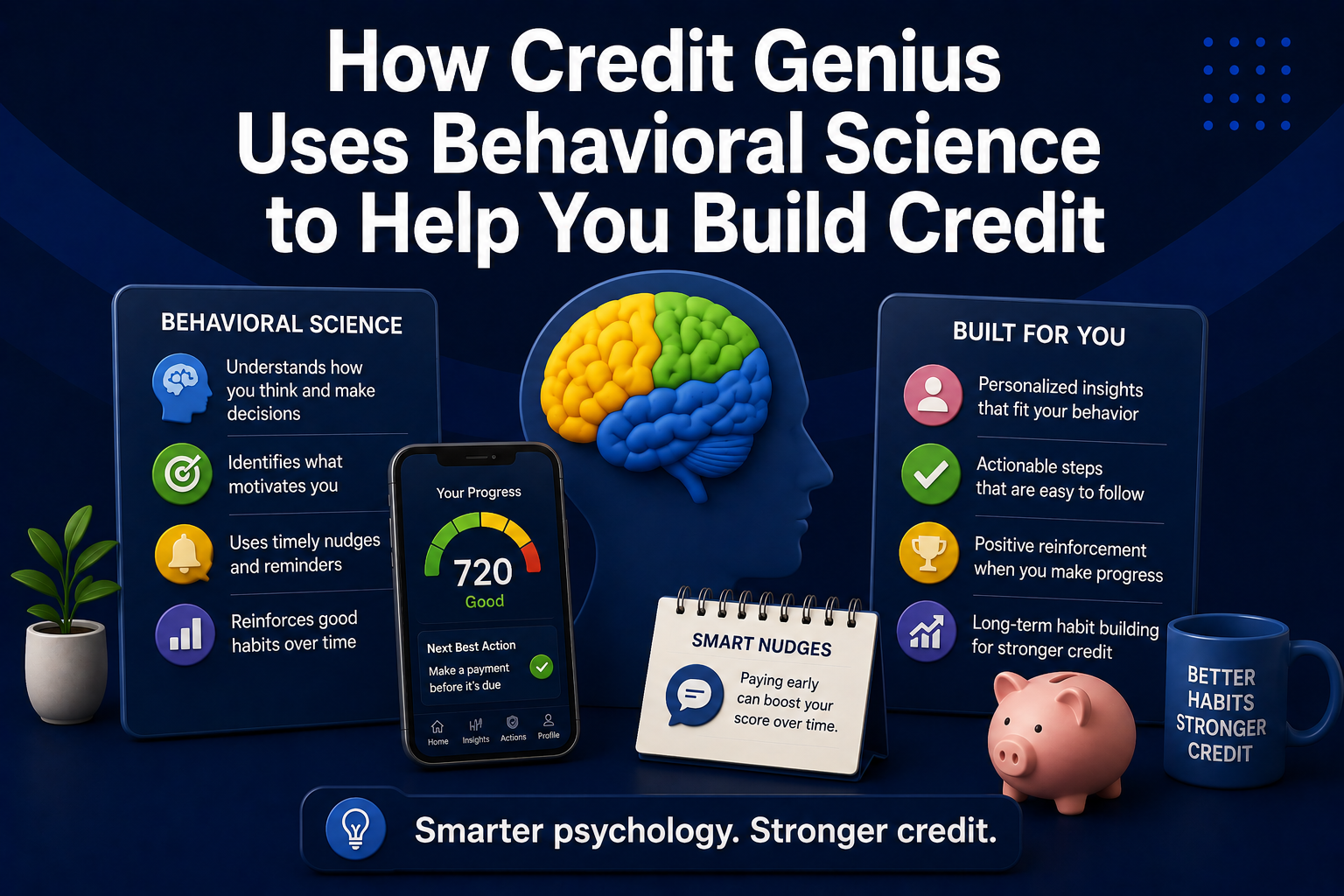
Most credit apps treat credit building as an information problem. They assume that if you show someone their score and explain what affects it, they will make better credit decisions. The data on financial literacy programs consistently shows this is not how behavior change actually works.
Credit Genius was built around a different premise: that credit building is primarily a behavior problem, not an information problem. And behavior change requires a different set of tools than information delivery. Here is how behavioral science principles are applied throughout the Credit Genius platform.
The gap between knowing and doing
Research in behavioral economics has consistently found that the gap between knowing what to do and actually doing it is one of the most stubborn problems in personal finance. People know they should pay their bills on time. They know they should keep their credit utilization low. They know they should check their credit report regularly. Most of them do not do these things consistently.
This is not a failure of intelligence or willpower. It is a reflection of how human motivation and habit formation actually work. Knowing the right behavior does not automatically produce the right behavior, particularly when the reward is abstract and distant while the effort is immediate and concrete.
Credit building has exactly this structure. The reward, a better credit score and better financial opportunities, may be months away. The effort, managing payments, monitoring accounts, making deliberate financial decisions, is required right now. Behavioral science offers a framework for bridging that gap.
Immediate feedback loops
One of the core principles of behavioral design is that behavior is reinforced when feedback is immediate and visible. When the connection between an action and its outcome is clear and fast, people are more likely to repeat the action.
Credit Genius provides real-time Experian credit monitoring that delivers immediate alerts when anything changes on your credit file. When a positive change appears, such as a rent payment being processed or a balance updating after a payoff, you see it right away. The feedback loop between action and outcome is compressed from weeks or months into days.
This immediacy matters. Behavioral research shows that delayed feedback significantly weakens its reinforcing power. A credit score update that arrives weeks after the action that caused it feels disconnected from the behavior. A real-time alert that says your score moved because of a specific action you took creates a much stronger link between the behavior and its reward.
Personalization and relevance
Generic advice is easy to ignore. Specific, relevant guidance directed at your particular situation is much harder to dismiss. This is why personalization is a behavioral principle as much as a product feature.
The Credit Genius AI credit assistant does not deliver the same tips to every user. It reads your actual Experian credit file and identifies the specific factors that are limiting your score right now. The guidance you receive is prioritized by impact and tailored to your individual situation.
When someone is told that their single biggest opportunity to improve their score is paying down a specific card from 78% utilization to below 30%, that is actionable and specific. It is behaviorally different from being told to keep utilization low in general. The specific, personalized instruction removes the ambiguity that causes inaction.
Gamification and intrinsic motivation
Credit Games, the gamified financial education component of Credit Genius, is built directly on behavioral science principles around motivation and habit formation. Games are one of the few contexts where humans voluntarily engage in repetitive, effortful behavior for extended periods. The reason is that games are designed to satisfy the psychological needs that drive sustained engagement: competence, progress, and autonomy.
Progress indicators. Seeing measurable progress toward a goal is one of the most reliable motivators in behavioral psychology. Credit Games use progress tracking to make the learning journey visible, giving users a concrete sense of advancement rather than an abstract sense of reading articles.
Streaks and consistency reinforcement. Streak mechanics, where users are rewarded for consecutive days or sessions of engagement, tap into loss aversion, one of the most powerful forces in behavioral economics. The desire not to break a streak motivates continued engagement even on days when motivation is otherwise low.
Challenges and goal setting. Structured challenges give users specific short-term goals to work toward, which behavioral research shows produces more consistent effort than open-ended aspirations. A user working toward completing a specific Credit Game challenge is more focused than one told to generally improve their financial literacy.
Reducing friction
Behavioral science consistently shows that reducing friction around desired behaviors dramatically increases the likelihood of those behaviors occurring. Every additional step between a user and a credit-building action is a point at which they may give up.
The Genius Rent Boost enrollment process is designed with friction reduction in mind. Rather than requiring users to gather extensive documentation, navigate complex forms, or wait weeks for results, the enrollment is streamlined and the backdating feature means results appear quickly. The behavioral principle at work is that the faster and easier a beneficial action is to take, the more people take it.
Similarly, having all credit-building tools, rent reporting, AI guidance, financial education, and monitoring in a single app reduces the friction of managing a credit improvement strategy across multiple platforms.
Social proof and community
One of the most powerful behavioral influences on human decision-making is observing what others in similar situations are doing and achieving. When people see that others like them have successfully improved their credit through specific actions, they are more likely to believe those actions will work for them and to take them.
The pilot data from Credit Genius’s 10,000-user launch showed measurable score improvements across the user base. When users can see that the behaviors the platform is encouraging are producing real outcomes for real people, the motivational power of that evidence compounds their own engagement.
Why this approach produces better outcomes
The behavioral science approach to credit building is not just philosophically interesting. It produces measurably better outcomes. Users who engage with Credit Games complete more credit-building actions. Users who receive personalized AI guidance act on recommendations more often than users who receive generic tips. Users with real-time monitoring catch problems faster and respond more quickly.
The connection between these behavioral design choices and actual credit score outcomes is the core of what Credit Genius is built around. A credit app that makes people feel informed but does not change their behavior has not actually helped them. An app that changes behavior through thoughtful design produces credit scores that reflect that change.
The bottom line
Credit building is not primarily an information problem. Most people already know the basics. It is a behavior problem, and behavior change requires immediate feedback, personalized guidance, reduced friction, and engagement mechanisms that sustain motivation over time.