
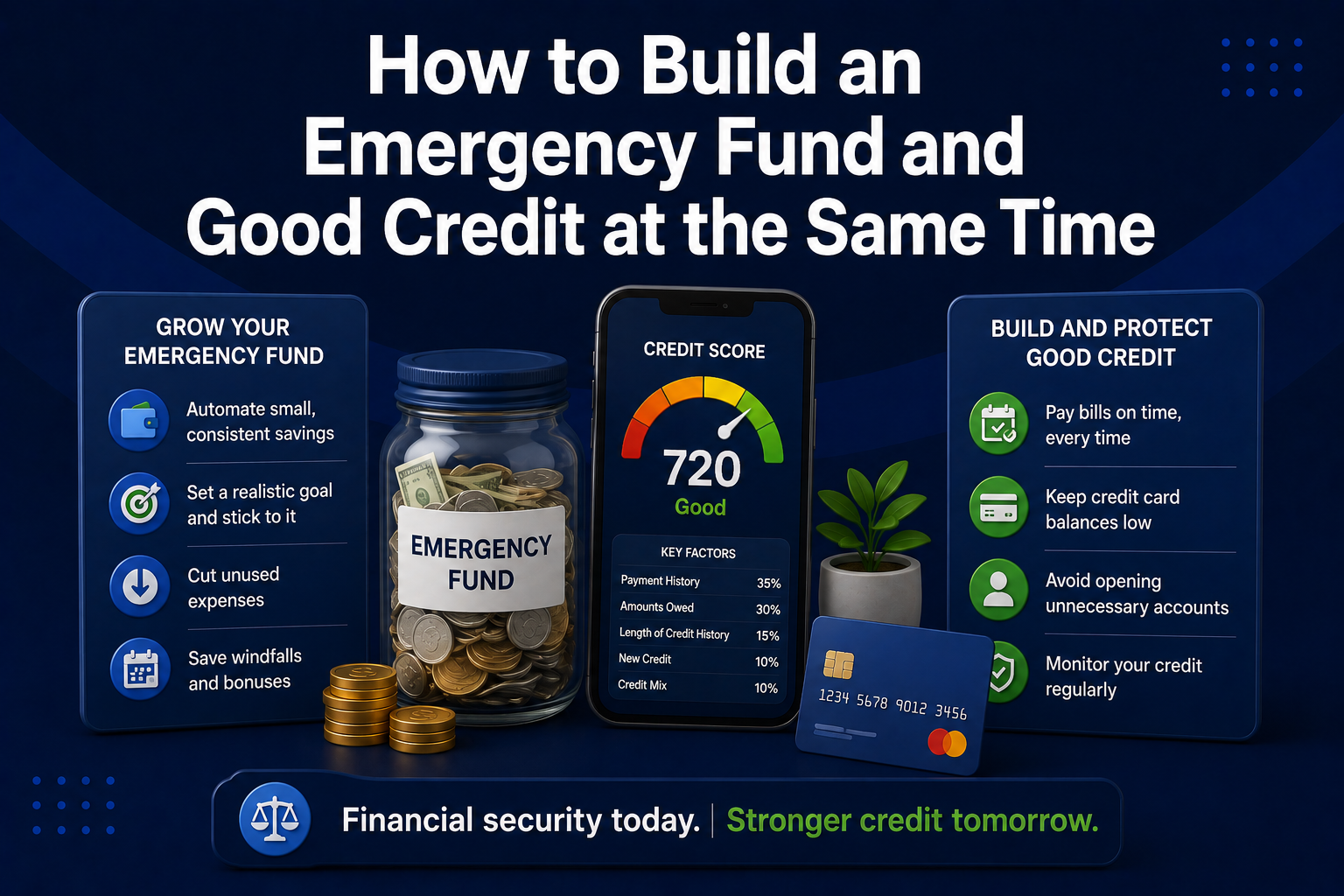
Most personal finance advice treats emergency funds and credit building as separate goals that you tackle one at a time. Build your emergency fund first, then work on credit. Or get your credit sorted, then focus on savings. In practice, most people do not have the luxury of addressing one before the other. They need both, and they need to be building both simultaneously.
The good news is that these two goals are not in conflict. With the right approach they reinforce each other. Here is how to build both at the same time without feeling like you are being pulled in two directions.
Why you need both and why they are connected
An emergency fund and good credit serve similar purposes from different directions. An emergency fund is liquid cash you can access immediately when something goes wrong. Good credit is the ability to access borrowed money quickly and cheaply when something goes wrong. Together they give you two layers of financial resilience.
The connection goes deeper. One of the most common ways people damage their credit is by missing payments during financial emergencies. A job loss, medical bill, or car repair that wipes out available cash can lead to missed minimum payments, which are among the most damaging credit events you can experience. An emergency fund prevents that cascade. It protects your payment history, the most important factor in your credit score, from being disrupted by events outside your control.
Building both simultaneously is not just possible. It is strategically smarter than doing one at a time.
Start with a minimum viable emergency fund
The conventional advice is to build three to six months of expenses as an emergency fund. For most people starting from scratch, that is an overwhelming target that can feel paralyzing. Do not start there.
Start with one month of essential expenses. Rent, utilities, minimum debt payments, and basic groceries. That number is smaller and more achievable. And one month of runway is enough to absorb most common financial emergencies without missing credit payments.
Once you have one month saved, you can begin directing more attention to credit building while continuing to grow the fund toward two and then three months over time. The one-month mark is the threshold that provides meaningful credit protection.
Use a credit builder loan to save and build credit simultaneously
This is one of the most elegant solutions to the save-and-build-credit challenge. A credit builder loan works by making fixed monthly payments into a locked savings account. The lender reports those payments to the credit bureaus while you build savings. At the end of the loan term you receive the accumulated balance back minus fees.
Every dollar you put into a credit builder loan is simultaneously building your emergency fund and your credit history. At the end of a 12-month term on a modest loan, you have a year of positive payment history on your credit file and a lump sum of savings returned to you. That savings can then go directly into your emergency fund.
The fixed monthly payment is also behaviorally useful. It automates the savings habit without requiring ongoing willpower decisions about whether to save this month.
Report your rent to build credit without touching your savings
One of the most powerful aspects of rent reporting is that it builds credit from payments you are already making. You are not redirecting money away from savings. You are not taking on new debt. You are simply getting credit recognition for a financial obligation you are already meeting.
Credit Genius reports rent payments to Experian with backdating of up to 24 months. This means you can add significant positive payment history to your credit file without any change to your monthly budget. Every dollar of your income continues flowing toward savings or debt reduction while your credit file grows simultaneously.
For someone trying to build both an emergency fund and good credit on a tight budget, rent reporting is the closest thing to a free credit-building move available.
Use a secured credit card with a small deposit
A secured credit card requires a deposit that becomes your credit limit. The deposit sits in your account, functioning similarly to a small emergency reserve while also enabling credit building. When you eventually close the card or graduate to an unsecured product, the deposit is returned to you.
The key is to use the card for one or two small recurring purchases, like a streaming subscription or a gas fill-up, and pay the full balance every month. This builds payment history and keeps utilization low without adding any meaningful debt to your financial picture.
Think of the deposit not as money spent but as money working double duty: it is securing your credit-building tool while remaining yours to reclaim.
Automate both goals
The most reliable way to build both an emergency fund and good credit simultaneously is to automate both so neither requires an active decision every month.
Set up autopay for the minimum payment on every credit account. Set up an automatic transfer to your savings account on payday. Enroll in rent reporting so your monthly payment goes to the bureau without any action on your part. With these three automations in place, you are building your emergency fund and your credit profile every month without having to think about it.
Automation removes the willpower requirement from both goals. And behavioral research is clear that habits sustained by automation are far more durable than those that depend on consistent conscious decisions.
How to split your extra money between the two goals
If you have extra money each month after covering essentials and minimum debt payments, a simple allocation framework is helpful.
Until you have one month of essential expenses saved, direct 70% of extra money toward the emergency fund and 30% toward credit building activities like paying down high-utilization cards. Once you hit one month saved, shift to 50/50. Once you hit three months saved, you can direct more aggressively toward credit optimization or other financial goals.
The exact percentages are less important than having a clear rule that prevents you from defaulting to doing nothing because the choice feels too complicated.
The bottom line
Building an emergency fund and good credit at the same time is not only possible, it is the smarter approach for most people. The emergency fund protects your credit from being damaged by financial shocks. The credit building ensures you have access to affordable borrowed money if the emergency fund is not enough.
Start small on both fronts. Automate what you can. Use tools like rent reporting and credit builder loans that let you build credit without diverting money away from savings. The two goals are more complementary than they are competing.