
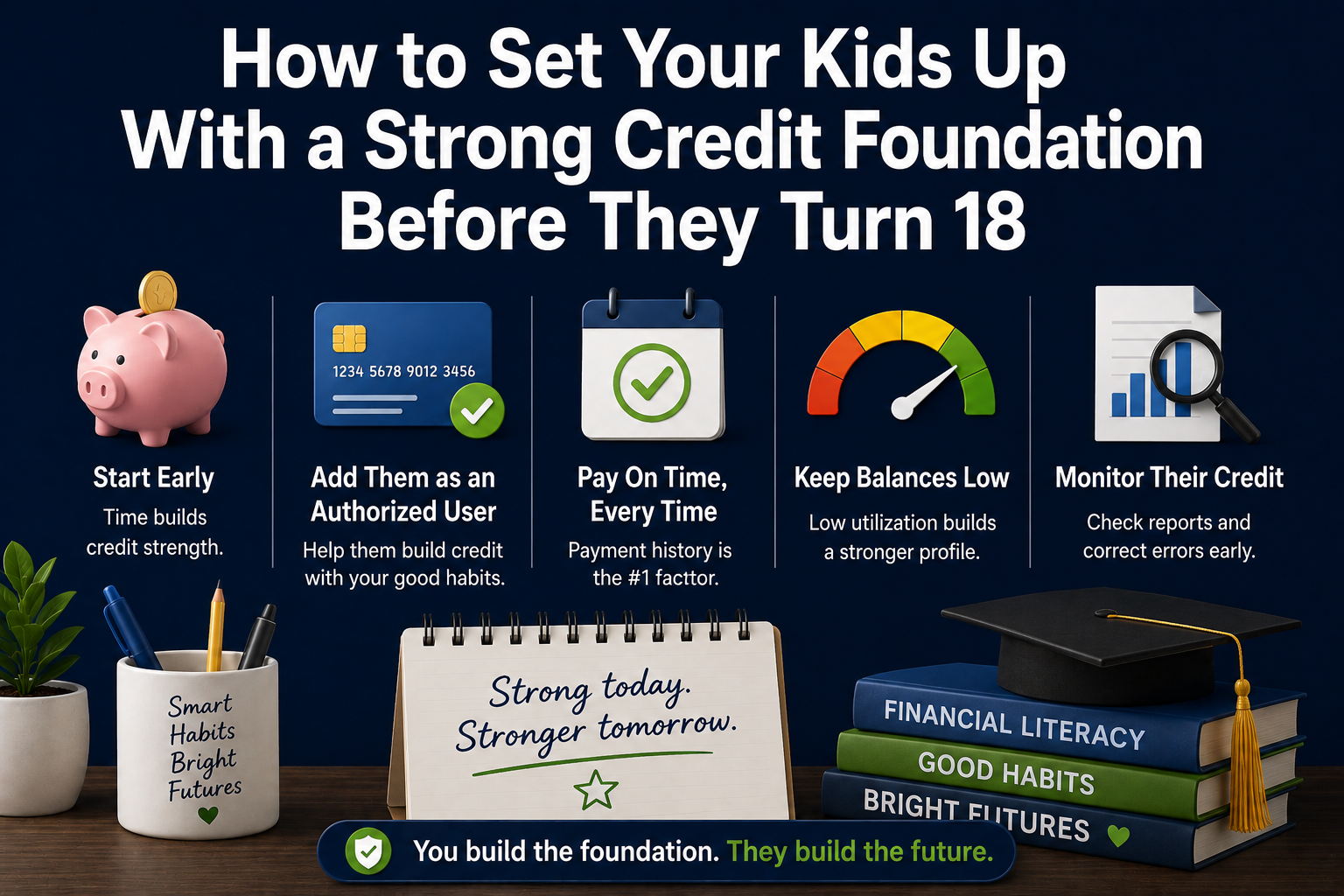
Most Americans turn 18 with no credit history whatsoever. They enter adulthood invisible to the credit system, which means their first apartment application, first car loan, and first major financial decision are all made at a disadvantage. It does not have to work that way.
Parents who understand how credit works can give their children a meaningful head start by taking a few deliberate steps before their kids reach adulthood. Here is what you can do and when.
Why starting before 18 matters
Credit scoring rewards length of history. The longer a positive account has been open, the more value it adds to a credit profile. A child added as an authorized user on a parent’s credit card at age 13 has five years of established credit history by the time they turn 18. A young adult who opens their first account at 18 starts from zero.
That five-year difference in account age matters when an 18-year-old applies for their first apartment or a 21-year-old applies for a car loan. The person with five years of established history in good standing is in a fundamentally different position than the person with six months.
Add your child as an authorized user
This is the most powerful credit-building tool available to parents for their children. When you add a child as an authorized user on your credit card, your payment history and account age on that card can appear on their credit report.
You do not need to give your child the physical card or allow them to use it. The credit benefit comes from the account appearing on their report, not from their usage. Many parents add a child as an authorized user, keep the card, and never let the child use it. The child still receives the credit history benefit.
The account you choose matters. Add your child to an account with a long history, a clean payment record, and low utilization. If your oldest card has a few late payments on it, consider whether a newer card with a cleaner record might be the better choice to put on your child’s report.
Different card issuers have different policies on authorized user age minimums. Some allow authorized users as young as 13. Others require 15 or 16. Check your card issuer’s policy before adding your child.
Freeze your child’s credit file
Children’s credit files are attractive targets for identity thieves because the fraud often goes undetected for years. A child whose Social Security Number is used to open fraudulent accounts may not discover the damage until they apply for their first credit card at 18 or their first apartment at 21.
Parents can place a credit freeze on their child’s file at all three bureaus. This prevents any new accounts from being opened in the child’s name. The freeze costs nothing and can be lifted when the child is ready to start using their credit.
The process requires submitting documentation proving your identity and your relationship to the child, including a birth certificate and your own ID. It takes a bit more effort than freezing an adult file but the protection is significant.
Teach the fundamentals before they need them
A credit foundation is most valuable when paired with understanding. A teenager who becomes an authorized user on your card but does not understand what credit is, how scores work, or why payment history matters is less equipped to manage credit independently than one who understands the system.
Walk your child through how credit scores are calculated. Explain what payment history is and why missing a payment is such a significant event. Show them what a credit report looks like. Explain what utilization means and why carrying high balances hurts your score even if you eventually pay them off.
Financial education tools like the Credit Games feature inside Credit Genius can make this more engaging for teenagers who find the subject dry when explained as a lecture. Gamified financial education builds knowledge retention in a way that passive content consumption typically does not.
When your child turns 16 to 18: prepare for independence
In the two years before your child turns 18, start preparing them to manage credit independently. Pull their credit report to see what is on it, confirm the authorized user account is reporting correctly, and check for any unexpected entries.
If you want your teenager to have their own credit account before 18, some credit card issuers offer student cards to 17-year-olds with a parent co-signer. A secured card with a small deposit is another option for older teenagers who are demonstrating financial responsibility.
Have a direct conversation about the plan for when they turn 18. Will they keep the authorized user account? Will you remove them? Will they open their own card? Knowing the plan in advance prevents the scenario where a newly independent adult is suddenly starting from scratch with their credit because the authorized user account was closed.
What not to do
Do not add your child to an account with a poor payment history or high utilization. The negative information transfers along with the positive. A card with a few missed payments in its history can hurt your child’s credit file rather than help it.
Do not give a teenager unrestricted access to a credit card before they understand how it works. The goal is to build a credit foundation, not to create an opportunity for spending that damages the very file you are trying to build.
Do not neglect the freeze. A child’s Social Security Number is a valuable identity theft target. Placing a freeze on their credit file is one of the most protective actions a parent can take.
The bottom line
The credit foundation you build for your child before they turn 18 is one of the most practical financial gifts you can give them. Adding them as an authorized user on a well-managed account, freezing their credit file to protect against identity theft, and teaching them how credit works before they need to use it sets them up to enter adulthood in a fundamentally stronger financial position than their peers.The work involved is minimal. The payoff is years of established credit history that will affect every major financial decision your child makes in their 20s and beyond.