
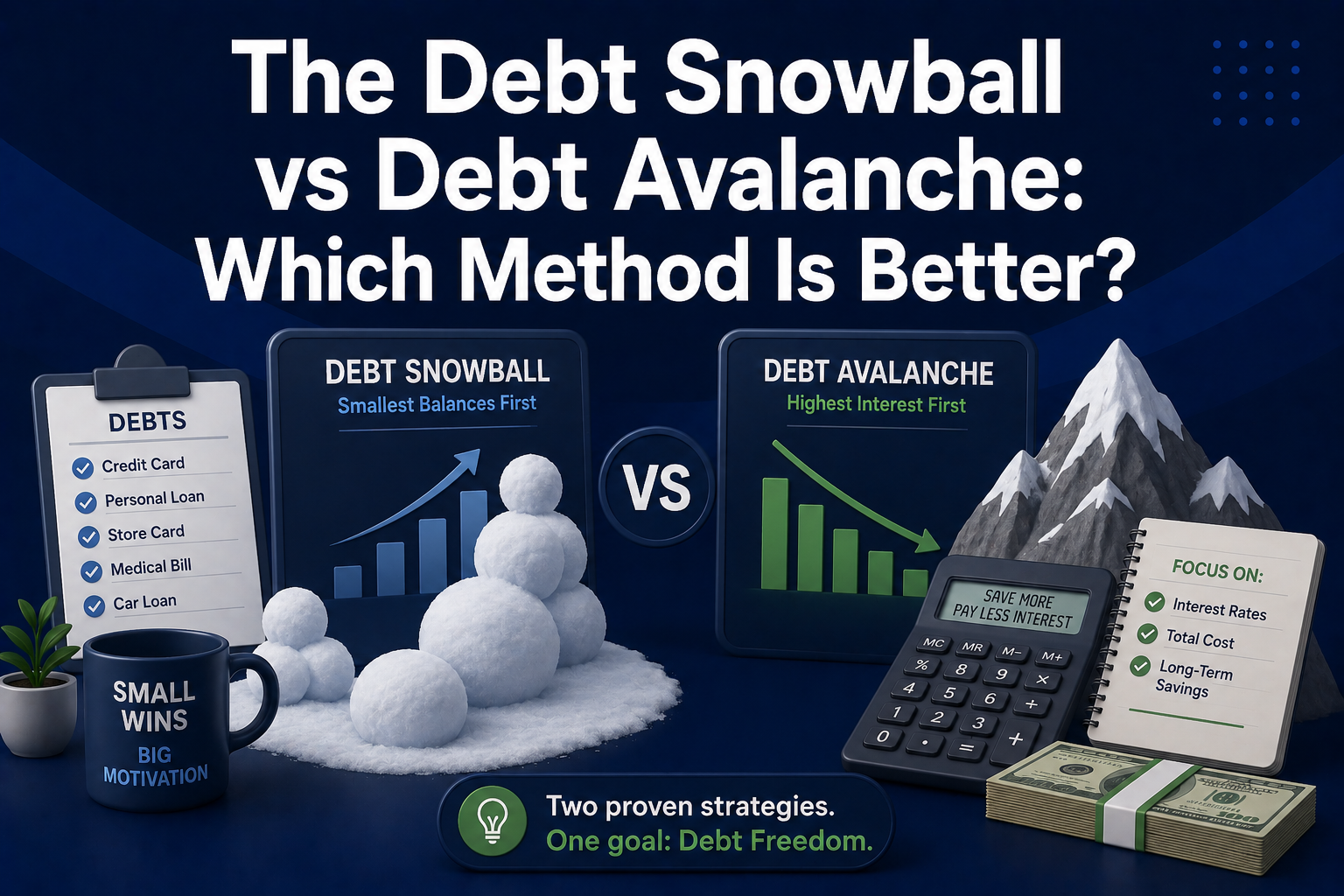
If you are trying to pay off multiple debts, two methods come up more than any others: the debt snowball and the debt avalanche. Both work. Both have legitimate advantages. The debate between them has been going on for years and the honest answer is that the better one depends on who you are, not just what the math says.
Here is a clear breakdown of how each method works, what the research says, and how to decide which one is right for your situation.
How the debt snowball works
The debt snowball method, popularized by personal finance commentator Dave Ramsey, works by paying off your smallest debt first regardless of interest rate. You make minimum payments on all your debts and put every extra dollar toward the smallest balance. When that debt is gone, you roll that payment amount onto the next smallest balance, and so on.
The name comes from the momentum that builds as you eliminate accounts. Each payoff frees up more cash to attack the next debt, and the payments compound like a rolling snowball gaining size.
Example: You have three debts. A 500 dollar medical bill, a 3,000 dollar credit card, and an 8,000 dollar car loan. Under the snowball method, you attack the 500 dollar bill first regardless of what interest rate any of them carry.
How the debt avalanche works
The debt avalanche method focuses on interest rates rather than balances. You make minimum payments on all your debts and put every extra dollar toward the debt with the highest interest rate. When that debt is paid off, you roll the payment to the next highest rate.
The logic is straightforward: high-interest debt costs more money over time. Eliminating it first reduces the total interest you pay across all your debts.
Example: Using the same three debts. If the 3,000 dollar credit card carries 24% interest, the 500 dollar medical bill carries 0%, and the car loan carries 7%, the avalanche method attacks the credit card first regardless of its balance being larger than the medical bill.
What the math says
The debt avalanche wins on math. Period. If you pay the same amount every month toward your debts, the avalanche method will cost you less money in total interest and get you debt-free faster in most scenarios. The higher the interest rates on your debts, the bigger the mathematical advantage of the avalanche.
The difference can be significant. Depending on your debt mix and interest rates, the avalanche method can save hundreds or even thousands of dollars in interest compared to the snowball.
What the research says about behavior
Here is where it gets interesting. A study published in the Journal of Marketing Research found that people who focused on paying off individual accounts entirely, which aligns with the snowball approach, were more likely to eliminate their overall debt than those who spread payments based on balances or rates.
The reason is psychological. Paying off a debt completely produces a sense of accomplishment that motivates continued effort. Mathematically optimal strategies do not help you if you abandon them three months in because the progress feels invisible.
If you have tried to pay off debt before and given up, the snowball method’s quick wins may be more valuable to your long-term outcome than the avalanche’s mathematical efficiency.
How each method affects your credit score
Both methods improve your credit score over time by reducing your total debt. But they affect your score differently in the short term.
Debt snowball and credit score: Paying off small balances quickly eliminates accounts, which can slightly affect your credit mix and account age. However, eliminating small balances also reduces overall utilization. If those small debts are revolving accounts like credit cards, paying them off reduces your utilization ratio and can produce noticeable score improvement quickly.
Paying down high-interest revolving debt reduces utilization on those accounts, which can improve your score faster in many cases. If your highest-rate debt is a credit card with a high balance relative to its limit, the avalanche method can produce meaningful score improvement earlier than the snowball in some scenarios.
For people who are building credit alongside paying off debt, the general principle is to prioritize paying down revolving credit card balances over installment debts when possible, since utilization is the second biggest factor in your credit score.
Which method should you choose?
Choose the debt snowball if: you have struggled to stay motivated with debt payoff in the past, you have several small debts that are making the situation feel overwhelming, you need quick wins to build momentum, or the interest rate differences between your debts are relatively small.
Choose the debt avalanche if: you are highly motivated and confident you will stick with the plan regardless of early progress, you have significant high-interest debt where the math advantage is substantial, or you are focused on minimizing total interest paid over time.
Consider a hybrid approach if: you have one or two very small debts you can eliminate quickly for a psychological win, then switch to the avalanche method for the remaining balances. This captures some motivational benefit of the snowball while shifting to the mathematically superior approach once momentum is established.
What both methods have in common
Regardless of which method you choose, the same fundamentals apply. Make minimum payments on all accounts every single month without exception. A missed payment damages your credit score far more than any debt payoff method can help it. Set up autopay on minimums so this never happens accidentally.
And while you are paying off debt, continue building positive credit history where possible. If you are renting and your payments are not being reported to the credit bureaus, adding rent reporting through Credit Genius runs in parallel with your debt payoff without requiring any additional money. It adds positive data to your Experian file while you work through your debt, so your credit profile is stronger on the other side.
The bottom line
The best debt payoff method is the one you will actually stick with. The avalanche wins on paper. The snowball wins for many people in practice. If you are disciplined and motivated, use the avalanche. If you need momentum and quick wins to stay engaged, use the snowball. If you are not sure, start with the snowball and switch once you have built the habit.The worst method is the one you abandon three months in. Pick the approach that fits how you are wired and commit to it.