
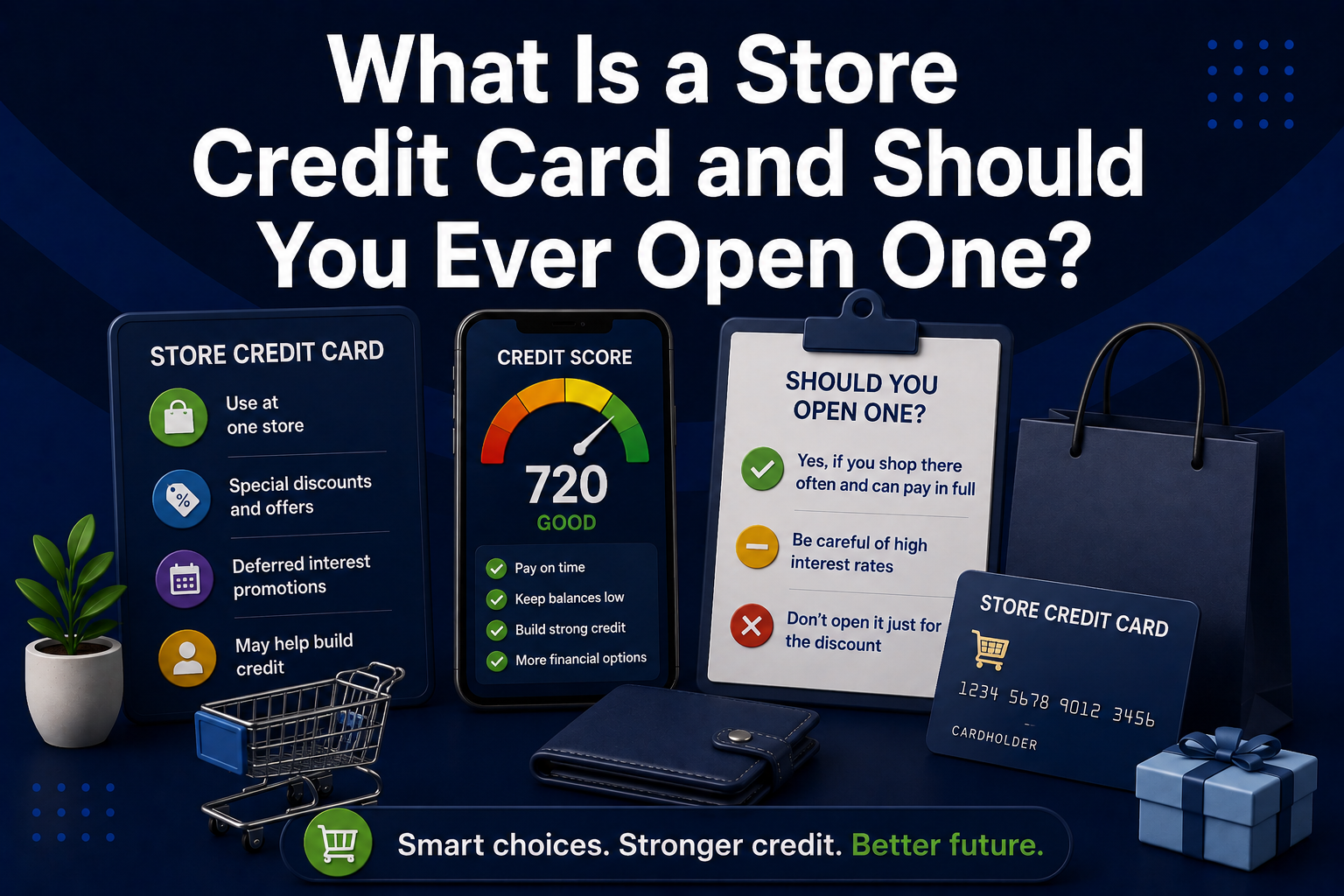
You are at checkout and the cashier offers you 20% off today’s purchase if you open a store credit card. It happens at clothing stores, furniture retailers, electronics chains, and department stores across the country. The offer sounds appealing in the moment. But the question of whether you should actually say yes is more complicated than the discount makes it seem.
Here is a clear-eyed look at what store credit cards are, how they affect your credit, and when they are and are not worth opening.
What a store credit card actually is
Store credit cards come in two varieties. A closed-loop store card can only be used at the specific retailer or family of retailers that issued it. An open-loop store card, sometimes called a co-branded card, carries a Visa, Mastercard, or similar network logo and can be used anywhere that network is accepted.
Both types are issued by banks or financial institutions on behalf of the retailer. Both report to the credit bureaus and function as revolving credit accounts for credit scoring purposes. The main difference is where you can use them and the rewards structure around them.
How store cards affect your credit score
The application causes a hard inquiry. Every store card application results in a hard inquiry on your credit report. Hard inquiries have a small temporary negative impact on your score, typically a few points, and remain on your report for two years. If you are opening one card the impact is minor. If you open several cards across different stores in a short period the cumulative effect is more significant.
It lowers your average account age. Every new account you open lowers your average account age, which is a factor in your credit score. If you have been building credit for five years and open a new store card, your average account age drops. The impact depends on how many other accounts you have and how old they are.
It adds available credit and potentially lowers utilization. A new card adds to your total available credit. If your existing balances stay the same, your overall utilization ratio drops, which is positive for your score. However, store cards typically come with low credit limits, so the utilization benefit may be modest.
High utilization on the store card itself is a risk. Store cards often have low credit limits, sometimes as low as 500 dollars. If you use the card for a significant purchase and carry a balance, the utilization on that specific card can be very high even if your overall utilization is fine. Per-card utilization is a factor in scoring models as well as total utilization.
Interest rates are typically very high. Store credit cards carry some of the highest interest rates in the consumer credit market, frequently 28% to 32% or above. If you carry a balance for even a month or two, the interest cost often exceeds any discount you received for opening the card.
When opening a store card makes sense
You are making a large purchase and will pay it off immediately. If you are buying 800 dollars of furniture and a store card gives you 20% off that purchase, you save 160 dollars. If you pay the balance in full before the statement closes, you pay no interest. The hard inquiry costs a few points temporarily. For a large purchase you were going to make anyway, this math can work in your favor.
You shop at that retailer frequently enough to use the rewards. Co-branded store cards often offer meaningful ongoing rewards at their partner retailer, sometimes 5% back or more. If you consistently spend significant amounts at a specific store, the rewards can accumulate to real value over time.
Store cards often have lower approval requirements than mainstream credit cards. For someone with a thin or fair credit file who cannot yet qualify for a better card, a store card can be a stepping stone. The key is to use it minimally, pay it in full every month, and treat it as a temporary tool while building toward better products.
When opening a store card does not make sense
You are about to apply for a major loan. If you are planning to apply for a mortgage, car loan, or any major credit product in the next six to twelve months, do not open any new credit accounts including store cards. The hard inquiry and the reduction in average account age are exactly what you do not want on your file before an important application.
You might carry a balance. If there is any chance you will not pay the full balance immediately, the interest rate on a store card will almost certainly cost you more than the discount you received. Store card interest rates are among the highest in the consumer credit market.
You already have multiple credit cards. If you already have several well-managed credit cards with good terms, a store card adds complexity and risk without meaningful credit benefit. A better card with broader acceptance and stronger rewards is almost always preferable.
You are opening it purely for the discount. Opening a card for a one-time discount on a small purchase, then never using it again, is rarely worth it. The hard inquiry, the account management overhead, and the risk of forgetting to pay the first statement on time make the discount a poor trade in most cases.
What to do if you already have store cards
If you have store cards you opened in the past and never use, do not rush to close them. Closing accounts reduces your available credit and can shorten your average account age. Leave them open, put a small recurring charge on them if possible to keep them active, and pay the balance in full each month.
If a store card has an annual fee you do not want to pay, call the issuer and ask whether they can waive it or convert the account to a no-fee product. If neither is possible, closing it may be worth the minor credit impact to eliminate the ongoing cost.
The bottom line
Store credit cards are not inherently bad. Used deliberately and paid off in full, they can offer genuine value for frequent shoppers at specific retailers and serve as an accessible entry point for people building credit. But the impulse offer at checkout, designed to catch you when you are already in spending mode, is rarely the right context for a considered credit decision.If a store card genuinely fits your spending habits and you will pay the balance in full every month, it can be a reasonable addition to your credit profile. If you are not sure, the answer is almost always to say no and revisit the decision when you are not standing at a register.