
How Veterans Can Use VA Benefits to Build Credit

Veterans face a unique set of credit challenges. Frequent relocations during service, deployments that disrupt financial routines, and the transition back to civilian life can all create gaps or complications in a credit history. At the same time, veterans have access to a set of financial benefits that, when used strategically, are among the most powerful credit-building tools available to anyone. Here is how veterans can use their benefits to build and strengthen their credit in 2026. The VA home loan: the most powerful credit-building tool available to veterans The VA home loan benefit is one of the most valuable financial tools available to any American, and it doubles as one of the most effective credit-building instruments available to veterans. VA loans require no down payment and no private mortgage insurance, two major barriers that prevent many non-veterans from accessing homeownership. They also tend to have competitive interest rates even for borrowers with lower credit scores than conventional loans require. From a credit-building perspective, a mortgage is an installment account that reports to all three credit bureaus every month. Every on-time payment adds to your payment history, the most important factor in your credit score. A veteran who uses their VA home loan benefit and makes consistent mortgage payments is building one of the most credible credit profiles possible. To use a VA loan, you must obtain a Certificate of Eligibility from the Department of Veterans Affairs. Your lender can often help you obtain this as part of the application process. Individual lenders set their own minimum credit score requirements for VA loans, typically between 580 and 620, though some lenders are more flexible. VA-backed credit products Several financial institutions offer credit products specifically designed for veterans and military members. These often have more favorable terms, lower minimum credit score requirements, and more flexibility in how income is evaluated compared to standard consumer products. Pentagon Federal Credit Union, Navy Federal Credit Union, and USAA are among the institutions known for veteran-friendly credit products. These include credit cards, personal loans, and auto loans with terms designed around the financial realities of military service and veteran status. Credit cards through these institutions used responsibly and paid in full each month add revolving credit history to your file. Personal loans add installment history. Both contribute to a more diverse and robust credit profile. Veteran-specific financial assistance programs The VA offers several financial assistance programs that, while not directly credit-building tools, can prevent the kinds of financial hardships that damage credit. Veterans in financial difficulty should explore these before missing payments on existing obligations. The VA’s financial counseling program provides free access to HUD-approved housing counselors who can help veterans navigate debt, budgeting, and credit challenges. The Servicemembers Civil Relief Act provides protections including interest rate caps on debts incurred before active duty, which can prevent debt from spiraling during deployment. Veterans experiencing financial hardship should contact the VA directly or reach out to veteran-focused nonprofits like the National Foundation for Credit Counseling, which offers free or low-cost credit counseling services. Using GI Bill housing allowances to build credit Veterans using the Post-9/11 GI Bill receive a monthly housing allowance when attending school more than half-time. This allowance is a predictable, regular income source that can support credit-building activities during the transition to civilian life. If you are renting while using GI Bill benefits, your housing allowance is covering a monthly payment that should be working for your credit. Rent reporting services submit that payment history to credit bureaus. Credit Genius reports rent to Experian and includes backdating, meaning if you have been renting during your educational period you can submit that history at once rather than starting from zero. Addressing credit gaps from service Many veterans return from service with thin credit files or gaps in their history. Deployments where financial activity was minimal, periods of on-base housing that did not require credit applications, and frequent moves that disrupted banking relationships can all create a credit file that does not reflect the discipline and reliability of military service. The solution is to start building immediately and use the tools available to you. If you have been renting since returning to civilian life, get that payment on your credit file through rent reporting. If you have not yet opened any credit accounts, a secured card or a credit builder loan from a veteran-friendly institution is a low-risk starting point. Veterans with thin files who enroll in rent reporting through Credit Genius and backdate their rental history can go from a limited credit profile to one with years of verified payment history in a matter of weeks rather than years. Protecting credit during financial hardship The transition from military to civilian employment is one of the highest-risk periods for credit damage. Income may be interrupted, new employment may not start immediately, and the cost structure of civilian life can be different from what was expected. Contact creditors proactively if you anticipate difficulty making payments. Many lenders have hardship programs that can defer or reduce payments temporarily without reporting a negative event to the bureaus. The key is to reach out before you miss a payment, not after. The Servicemembers Civil Relief Act provides additional protections for active-duty members, including the ability to reduce interest rates on pre-service debts to 6% and protections against certain types of legal action during deployment. The bottom line Veterans have access to some of the most powerful credit-building tools available in the US financial system. The VA home loan benefit alone is a credit-building instrument that most Americans cannot access. Combined with veteran-friendly credit products, GI Bill housing allowances, and rent reporting to capture the housing payments you are already making, veterans have a clear path to building a strong credit profile.The credit gaps that sometimes come with military service are real but they are fixable. Start with the payments you are already making, use the benefits you have earned, and build from there.
What Credit Score Do You Need to Buy a House in 2026?

Buying a home is the largest financial decision most people make in their lifetime and your credit score is one of the most important factors in determining whether you can do it and at what cost. The minimum score you need depends on the type of loan you are applying for, and the score that gets you the best rate is higher than most people expect. Here is a clear breakdown of what credit score you actually need in 2026 and what the difference between a good and a great score means for your mortgage. Minimum credit scores by loan type Conventional loans: 620 minimum. Conventional loans, which are not backed by a government agency, typically require a minimum credit score of 620. However, a score at or near the minimum will result in higher interest rates and stricter requirements around down payment and debt-to-income ratio. FHA loans: 580 minimum with 3.5% down, 500 with 10% down. FHA loans are insured by the Federal Housing Administration and are designed for borrowers with lower credit scores or smaller down payments. A score of 580 qualifies you for a 3.5% down payment. Scores between 500 and 579 require a 10% down payment. Below 500, FHA financing is generally not available. VA loans: No official minimum, but lenders typically require 580 to 620. VA loans for eligible veterans, active-duty service members, and surviving spouses do not have a government-set minimum credit score. Individual lenders set their own requirements, which typically fall between 580 and 620. USDA loans: 640 recommended. USDA loans for rural and suburban home purchases have no official minimum but most lenders require at least 640 for automated approval. Below that, manual underwriting may be required. Jumbo loans, which exceed conforming loan limits, have stricter requirements. Most lenders require a minimum score of 700 to 720 and some set the bar even higher. What the score means for your interest rate Meeting the minimum score is only part of the equation. The rate you are offered depends heavily on where your score falls within lender tiers. The difference between a 640 score and a 760 score can translate to a difference of 1% or more in your mortgage rate. On a 350,000 dollar 30-year mortgage, a 1% difference in interest rate translates to approximately 200 dollars per month in payment difference and over 70,000 dollars in total interest paid over the life of the loan. The credit score you bring to a mortgage application is not just a qualification hurdle. It is a financial variable with real, lasting dollar consequences. General rate tier thresholds used by most conventional lenders in 2026 fall roughly as follows. Scores below 640 receive the least favorable rates. Scores from 640 to 679 are considered subprime by most conventional lenders. Scores from 680 to 719 are in the standard range. Scores from 720 to 759 qualify for better rates. Scores of 760 and above typically receive the best available rates. Which credit score do mortgage lenders use? Mortgage lenders do not use the VantageScore shown on most free credit monitoring apps. They pull specific FICO score versions from all three bureaus: FICO Score 2 from Experian, FICO Score 4 from TransUnion, and FICO Score 5 from Equifax. For most mortgage applications, they use the middle of the three scores. For joint applications with a co-borrower, lenders typically use the lower of the two middle scores. This means that if one borrower has a 740 and the other has a 660, the application is evaluated at 660. This is why knowing your actual FICO mortgage scores, not just your VantageScore from a monitoring app, is important when preparing to apply. The number on your app and the number your lender sees may be meaningfully different. How far in advance should you work on your credit? Ideally, at least 12 months before you plan to apply. This gives you time to dispute errors, reduce utilization, build additional payment history, and let any improvements work their way through the scoring system. If you are within six months of applying, the most impactful actions are paying down credit card balances to reduce utilization, ensuring there are no errors on your credit report, and avoiding any new credit applications that would add hard inquiries. For renters who are planning to buy in the next one to three years, rent reporting through Credit Genius is one of the most effective preparatory steps available. Adding verified rent payment history to your Experian file, including backdated history, can meaningfully improve your score over the months leading up to a mortgage application. What to do if your score is not there yet If your score is below where you need it to be, a realistic improvement timeline depends on what is holding it down. High utilization can be addressed in one to two billing cycles by paying down balances. Errors can be corrected within 30 days through the dispute process. Building additional payment history takes longer but compounds steadily over months. Most people who are 20 to 40 points below their target can reach it within six to twelve months of consistent, focused effort. A 50 to 80 point gap typically takes twelve to twenty-four months. Gaps above 100 points often require a longer timeline depending on what is causing them. Using a tool like Credit Genius that analyzes your specific credit profile and tells you exactly which actions will move your score most efficiently can significantly shorten this timeline by helping you focus on the highest-impact actions rather than applying generic advice. The bottom line The minimum credit score to buy a house in 2026 is 500 for FHA loans with a large down payment and 620 for conventional financing. But the score that gets you the best rate and the lowest total cost of borrowing is 760 or above.If homeownership is a goal, treat your credit score as a financial variable worth actively managing in the years leading up to your purchase.
Can a Debt Collector Sue You and What Happens to Your Credit?

Getting calls from a debt collector is stressful enough. The possibility of being sued on top of that is something a lot of people push to the back of their minds rather than confront directly. That tends to make the situation worse. Here is a clear, practical breakdown of whether debt collectors can sue you, under what circumstances they are likely to, and what happens to your credit at each stage. Yes, debt collectors can sue you Debt collectors, both the original creditor and third-party collection agencies, have the legal right to sue you in civil court to recover money you owe. If they win, the court issues a judgment against you, which can lead to wage garnishment, bank account levies, or liens on property depending on the laws in your state. That said, lawsuits cost money and time. Most debt collectors only pursue legal action when the amount owed is significant enough to justify the expense, typically debts of several thousand dollars or more, and when they believe you have income or assets worth pursuing. The statute of limitations matters Every state has a statute of limitations on debt collection lawsuits. This is the window of time during which a creditor or collector can legally sue you to recover a debt. After this window closes, the debt becomes time-barred, meaning they can no longer successfully sue you for it in most circumstances. The statute of limitations varies by state and by type of debt, typically ranging from three to six years for credit card debt and personal loans. The clock generally starts from the date of your last payment or last account activity. An important warning: making a partial payment on a time-barred debt can restart the statute of limitations in some states, giving the collector a fresh window to sue. Before making any payment on a very old debt, understand your state’s rules and consider consulting a consumer law attorney. What happens to your credit before a lawsuit By the time a debt reaches a collections agency, significant credit damage has usually already occurred. The original creditor will have reported the account as delinquent at the 30, 60, and 90-day marks, each stage causing progressive credit score damage. Eventually the account may be charged off, which means the original creditor writes it off as a loss and either sells it to a collections agency or refers it to one. The collections account itself then appears on your credit report as a separate entry, adding another negative mark. At this point your credit score has typically taken a significant hit and the debt has been on your report for some time. What happens to your credit if you are sued A lawsuit itself does not appear on your credit report. The underlying debt and the collections account already do, so the filing of a lawsuit does not create additional credit damage on its own. What does affect your credit is a judgment. If the collector wins in court and a judgment is entered against you, that judgment may appear as a public record on your credit report depending on the bureau and the type of debt. Judgments are serious derogatory marks and can significantly affect your ability to borrow. The three major credit bureaus, Experian, TransUnion, and Equifax, removed most civil judgments from credit reports in 2017 following concerns about data accuracy. However, some judgments may still appear depending on how they are reported and by which entity. What to do if you are contacted by a debt collector Request debt validation in writing. Under the Fair Debt Collection Practices Act, you have the right to request written validation of the debt within 30 days of the collector’s first contact. They must verify that the debt is yours and that the amount is correct before continuing collection activity. Know your statute of limitations. Before engaging with a very old debt, confirm whether it is time-barred in your state. A collector can still attempt to collect a time-barred debt, but they cannot successfully sue you for it. Do not ignore a lawsuit summons. If you are served with a lawsuit, respond by the deadline. Ignoring it results in a default judgment against you, which the collector wins automatically without having to prove their case. Consider your options. Depending on your situation, negotiating a settlement, setting up a payment plan, or consulting a consumer law attorney may be appropriate. Many consumer attorneys offer free consultations for debt collection issues. How to rebuild after debt collection damage Whether or not a debt ends in a lawsuit, the credit damage from a collections account is real and takes time to recover from. The collections account stays on your report for seven years from the original delinquency date. The most effective path forward is to focus on building positive credit history alongside the negative mark. Every month of on-time payments on active accounts dilutes the impact of the collection over time. Rent reporting through Credit Genius adds verified positive payment history to your Experian file, which can help offset the damage of older negative marks as you rebuild. Monitoring your credit file closely during this period is particularly important. Use a real-time monitoring tool so you are immediately aware of any new collection activity or judgment that appears on your report. The bottom line Debt collectors can sue you, but they do not always choose to. The credit damage from a collections account is real regardless of whether a lawsuit follows. Knowing your rights under the Fair Debt Collection Practices Act, understanding the statute of limitations in your state, and responding promptly if you are served with legal papers are the most important things you can do to protect yourself. Do not ignore debt collection situations hoping they will resolve themselves. They rarely do, and the longer a debt remains unaddressed the fewer options you have.
What Is a Goodwill Letter and Does It Actually Work?
A goodwill letter is a written request to a creditor asking them to remove a negative mark from your credit report as an act of goodwill. It is not a legal right. It is not a dispute. It is a polite, direct appeal to the creditor’s discretion, asking them to do something they are not required to do. Does it work? Sometimes. Here is everything you need to know about when and how to use one. When a goodwill letter is appropriate A goodwill letter makes sense in a specific type of situation: you have a negative mark on your credit report that is accurately reported, you have since paid the debt or brought the account current, and the negative mark represents an isolated incident in an otherwise clean credit history. The most common use cases are a single late payment that was out of character for your payment history, a missed payment that happened during a specific hardship like a job loss, medical emergency, or family crisis, and a collection account that has since been settled or paid in full. Goodwill letters are not appropriate for disputing accurate information you simply do not like or for trying to remove a pattern of negative behavior. Creditors are far more likely to respond positively to a genuine, isolated incident than to a request that sounds like an attempt to clean up systemic credit problems. What makes a goodwill letter effective Be specific about what you are asking. State clearly which account and which negative mark you are requesting be removed. Include the account number, the date of the late payment or negative event, and the bureau or bureaus where it appears. Acknowledge the situation honestly. Do not deny that the late payment happened or suggest it was the creditor’s fault. Acknowledging what occurred and taking responsibility for it is a more credible foundation than deflection. Explain the circumstances briefly. If the missed payment happened during a genuine hardship, explain it in one or two sentences. Keep it factual and concise. You are not writing a novel. You are providing context that makes the request feel reasonable. Highlight your payment history before and after. Point out that this incident was out of character. If you had years of on-time payments before and have resumed on-time payments since, say so. The more isolated the incident appears, the more compelling the goodwill argument is. Be polite and professional. You are asking for a favor. The tone should reflect that. Avoid being demanding, accusatory, or overly emotional. A measured, respectful letter is far more effective than one that comes across as frustrated or entitled. Who to send it to Send the letter to the original creditor, not to the credit bureau. The bureau cannot remove accurate information on its own. Only the creditor who reported the information has the ability to request its removal. The creditor’s Customer Service or Credit Dispute Address can usually be found on either your account statement or on their website. In addition, sending your letter via Certified Mail allows you to prove that the creditor received your letter; proving receipt may become important when you follow-up with the creditor regarding the status of your claim. Some people also call the creditor directly before sending a letter to ask whether goodwill adjustments are something they consider. Some creditors have explicit policies against them, in which case sending a letter is unlikely to produce a result. Knowing this upfront saves time. Does it actually work? Honestly, it depends. There is no published success rate because creditors are not required to track or report their responses to goodwill requests. What is generally understood from consumer experience is that goodwill letters work more often than most people expect when used correctly. Large banks and major creditors tend to have stricter policies and are less likely to grant goodwill removals. Smaller banks, credit unions, and some credit card issuers are more flexible and more likely to exercise discretion. The best predictor of success is your overall history with the creditor. A long-standing customer with years of on-time payments who missed one payment during a documented hardship has a much stronger case than someone with a shorter or more mixed history. What to do if it does not work If the creditor declines or does not respond, you still have options. You can try calling to speak with a supervisor or a customer relations representative who may have more discretion than the standard customer service team. You can send a second letter if some time has passed and your circumstances have changed. Once you’ve tried the goodwill route, you should now be focused on creating positive credit history. When you surround one negative remark (such as a late payment) with many years of good payments, its effect diminishes. The best way to recover from a lower score is consistently doing something positive, regardless of how long it takes to get the bad mark removed. Tools like Credit Genius that provide real-time Experian monitoring and AI-powered guidance on what positive actions will move your score most efficiently are particularly useful during this kind of recovery period. The bottom line A goodwill letter is not a guaranteed fix and it is not always the right tool. But for a specific set of circumstances, specifically a single isolated negative mark that has since been resolved, it is worth attempting. It costs nothing but time and it occasionally works. Write it honestly. Keep it concise. Send it to the right person. And regardless of the outcome, keep building the positive credit history that makes the letter’s argument compelling in the first place.
What Is Rapid Rescoring and When Should You Use It?
Rapid rescoring is one of the lesser-known credit tools available to borrowers, and it can make a significant difference in specific situations. Most people have never heard of it. Those who have often do not know exactly how it works or when it is actually worth using. Here is a clear explanation of what rapid rescoring is, how the process works, and the situations where it genuinely makes sense. What rapid rescoring actually is Rapid rescoring is a process where a lender, typically a mortgage lender, works with a credit bureau to update your credit file quickly and generate a new credit score that reflects recent changes. Under normal circumstances, changes to your credit file such as paying down a balance or correcting an error can take 30 to 45 days to be reflected in your credit score. Rapid rescoring compresses that timeline to as little as three to five business days. The key point is that rapid rescoring is not something you can request directly. It must be initiated by a lender on your behalf. It is also not free, though the cost is typically absorbed by the lender rather than charged to the borrower. How the process works When a lender initiates rapid rescoring, they submit documentation of recent changes to your credit file directly to the credit bureau. This might include proof that you paid down a credit card balance, documentation that an error has been corrected by the creditor, or evidence that a collection account has been settled. The bureau processes the updated information and generates a new credit score that reflects the changes. The lender then uses this updated score for your application rather than the score from the original pull. Rapid rescoring only updates the information that is submitted with documentation. It cannot add positive information that does not exist or remove accurate negative information. It is a tool for making sure your file reflects changes that have already happened, not a way to manufacture a better score. When rapid rescoring makes sense You are close to a score threshold for a better rate. This is the most common use case. If your score is 717 and a score of 720 or above would qualify you for a significantly lower mortgage rate, and you have recently paid down a balance or had an error corrected that would push you over that threshold, rapid rescoring lets you capture that improvement before closing rather than waiting for it to appear naturally. An error was recently corrected. If you discovered an error on your credit report, disputed it successfully, and had it removed or corrected, rapid rescoring allows the corrected file to be reflected in your score immediately rather than waiting for the normal update cycle. You paid down a significant balance just before applying. If you paid off a credit card balance to reduce your utilization before a mortgage application, that payoff may not yet be reflected in the score the lender pulled. Rapid rescoring can capture the lower utilization and the improved score that comes with it. You are on a tight timeline. If you are closing on a home purchase or refinance within a matter of days and a score improvement would meaningfully affect your rate or approval, rapid rescoring is one of the few tools that can produce a result fast enough to matter. When rapid rescoring does not make sense Rapid rescoring is not useful if you have not actually made changes to your credit file. If you are hoping it will somehow improve a score without underlying changes to support the improvement, it will not. The process only reflects what has already happened. It is also not a substitute for longer-term credit building. If your score is significantly below the threshold you need, a few points from rapid rescoring will not bridge a large gap. It is most effective when you are already close and just need the score to catch up to the changes you have already made. How to ask for rapid rescoring If you think rapid rescoring might help your situation, raise it with your mortgage lender or loan officer. Ask whether they offer it and whether your situation qualifies. Come prepared with documentation of the changes that have been made to your credit file, whether that is a payoff confirmation, a letter from a creditor confirming an error correction, or a settlement receipt. Not all lenders offer rapid rescoring and those that do have their own processes for initiating it. Your loan officer is your starting point. The bottom line Rapid rescoring is a niche but genuinely useful tool for people in specific situations, primarily those who are close to a major loan application and have recently made changes to their credit file that have not yet been reflected in their score. It is not a magic fix and it is not available directly to consumers, but for the right situation it can make a meaningful difference in your rate or approval outcome. If you are actively working to build your credit ahead of a major financial decision, tools like Credit Genius that monitor your Experian file in real time and provide personalized guidance on what actions will move your score most efficiently can help you get to the score you need before rapid rescoring even becomes necessary.
The Credit Score Guide for People in Their 20s

Your 20s are the most consequential decade for credit. Not because the stakes are highest right now, they are not, but because the habits and history you build in your 20s compound over time in ways that make everything harder or easier in your 30s, 40s, and beyond. This guide covers everything you need to know about credit in your 20s: what your score should look like at different stages, what moves matter most, what mistakes are most common, and how to set yourself up for the decade ahead. What a normal credit score looks like in your 20s The average credit score for Americans aged 18 to 25 is in the low-to-mid 600s. For those aged 26 to 35 it rises to the mid-to-high 600s. These numbers reflect the reality that most people in their 20s are still building their credit file from scratch. If you are in your early 20s with a score in the 600s, that is not a problem. It is a starting point. If you are in your late 20s with a score below 620, it is worth understanding why and taking deliberate steps to improve it before the financial decisions that require strong credit become more pressing in your 30s. A score of 700 or above by the time you hit 30 is an achievable and valuable target. Here is how to get there. Early 20s: build the foundation The priority in your early 20s is getting a credit file established. Many people at 18 or 19 are credit invisible, meaning they have no credit history at all. The credit system cannot score you and lenders treat invisibility similarly to bad credit. Become an authorized user. Ask a parent or family member to add you to a long-standing account with good history. This is the fastest way to go from invisible to scoreable without opening any accounts yourself. Open your first account. A student credit card or secured card used for one small recurring purchase paid off every month is the cleanest credit-building tool available. Keep utilization low and never miss a payment. Report your rent. If you are renting an apartment or room, get that payment on your credit file. Credit Genius reports rent to Experian with backdating, meaning months of history you have already built can be added at once. For a 22-year-old with a thin file, this can be transformative. Mid 20s: build momentum and avoid common mistakes By your mid 20s you should have at least a year or two of credit history. This is when the most common and costly mistakes tend to happen. Do not miss payments. A missed payment in your mid 20s stays on your report until your early 30s. That is exactly when you are likely to apply for a car loan, a mortgage, or a rental in a competitive market. Set up autopay on everything. Do not max out your cards. High utilization is one of the fastest ways to tank a score that took years to build. Keep balances below 30% of your limit. Below 10% is better. Do not open accounts impulsively. Store cards, promotional financing, and sign-up bonus cards are tempting. Every application is a hard inquiry and every new account lowers your average account age. Be selective. Do not close old accounts. The length of your credit history matters. Closing old accounts shortens it and reduces your available credit. If a card has no annual fee, leave it open. Late 20s: optimize and prepare for the 30s Your late 20s are when credit starts to matter in more consequential ways. You may be looking at buying a home, taking out a car loan, starting a business, or applying for apartments in more competitive markets. The credit decisions you made in your early and mid 20s are showing up in your score now. Know your score and what is driving it. Pull your full credit report from all three bureaus and understand what is in it. Look for errors. Look for accounts you forgot about. Look for anything that should have fallen off but has not. Diversify your credit mix if you have not already. Having both revolving accounts like credit cards and installment accounts like a car loan, student loans, or a credit builder loan demonstrates to scoring models that you can manage different types of credit. Credit mix accounts for 10% of your FICO score. Do not open new accounts before major applications. If you are planning to apply for a mortgage in the next six to twelve months, stop opening new accounts now. New accounts lower your average account age and add hard inquiries at exactly the wrong time. Pay down high balances. If you have been carrying balances on credit cards, your late 20s are the time to get serious about paying them down. Lower utilization produces faster score improvement than almost anything else in the short term. The five factors and what they mean in your 20s Payment history (35%). The most important factor. A single missed payment can cost 50 to 100 points and stays on your report for seven years. Autopay is non-negotiable. Credit utilization (30%). Keep balances low relative to your limits. This is the fastest variable you can control directly. This is the factor that rewards starting early. Every year you build in your 20s is a year of history working for you in your 30s. Credit mix (10%). A mix of revolving and installment accounts is better than one type alone. Do not open accounts just for this reason, but be aware of it when you are considering new products. New credit (10%). Hard inquiries and new accounts have a small, temporary negative impact. Space out applications and avoid opening multiple accounts at once. Tools worth using in your 20s Monitoring your credit file regularly is not optional in your 20s. Errors happen, identity theft happens, and the only way to catch these things is to look at your report.
How to Remove a Collections Account From Your Credit Report
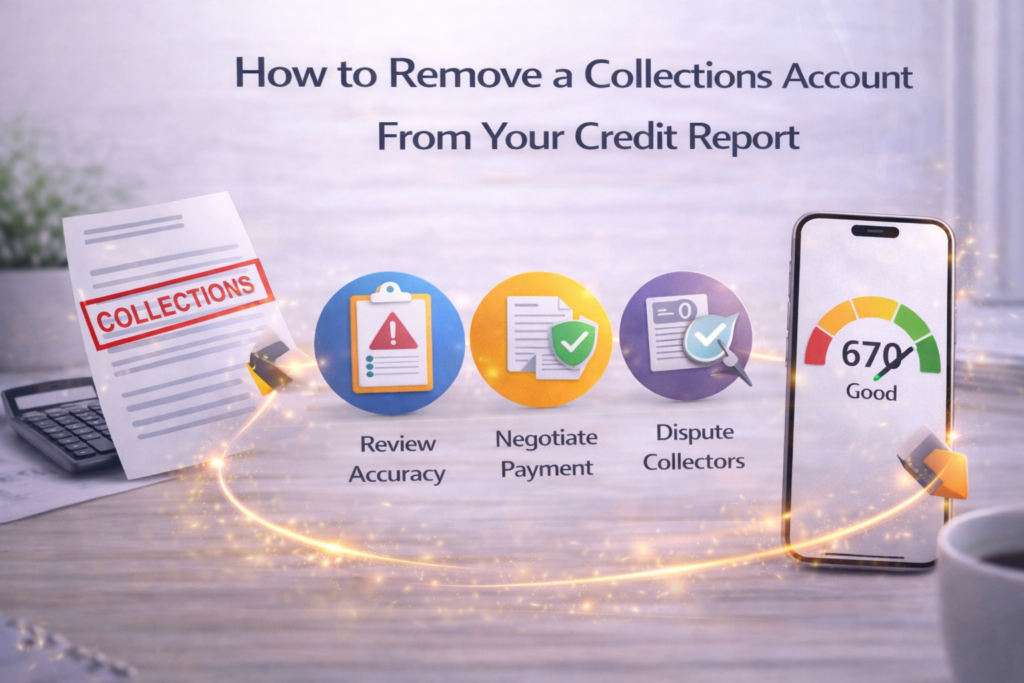
A collections account is one of the most damaging things that can appear on your credit report. It signals to lenders that a debt went unpaid long enough that the original creditor gave up trying to collect it and handed it off to a collections agency. The impact on your score can be significant and the mark can stay on your report for up to seven years. The good news is that in some circumstances collections accounts can be removed before their seven-year expiration. Here is everything you need to know about how to make that happen. First: understand what you are dealing with A collections account stays on your credit report for seven years from the date of the original delinquency, which is the date you first missed the payment that eventually led to the account being sent to collections. Paying off the collection does not restart this clock or automatically remove the account. There are important recent changes to how medical collections are treated. Medical collections under 500 dollars were removed from credit reports in 2023 and are no longer factored into credit scoring by the major bureaus. Medical collections over 500 dollars that have been paid are also now excluded from credit reports in many cases. If you have medical collections, check your reports to see whether they are still appearing. For all other types of collections, the following options are available. Option 1: Dispute it if it is inaccurate The most straightforward path to removing a collections account is disputing it if it contains inaccurate information. This is more common than you might think. Pull your credit reports from all three bureaus at annualcreditreport.com and review the collections account carefully. Look for errors in the account number, the original creditor, the date of first delinquency, the balance, or whether the account actually belongs to you. If anything is inaccurate, file a dispute with the bureau reporting the error. Under the Fair Credit Reporting Act, the bureau must investigate within 30 days. If the collections agency cannot verify the information accurately, the account must be removed or corrected. File disputes with documentation. A vague dispute without supporting evidence is easier to dismiss. If you have bank records, payment confirmations, or any documentation that contradicts what is on your report, include copies with your dispute. Option 2: Request a pay-for-delete agreement A pay-for-delete arrangement is an agreement with the collections agency where they agree to remove the account from your credit report in exchange for payment. This is not a legal requirement and not all collectors will agree to it, but some will, and it is worth attempting before paying. The process involves contacting the collections agency, either by mail or phone, and asking whether they would agree to delete the account from your credit report in exchange for payment in full or a negotiated settlement amount. Get any agreement in writing before you pay. A verbal agreement is not enforceable. If the agency agrees, make the payment and then verify within 30 to 60 days that the account has been removed from your reports at all three bureaus. If it has not been removed, follow up with the agreement in writing. Note that pay-for-delete is less effective than it once was because some major credit bureaus have policies against honoring these agreements. Results vary and are not guaranteed. Option 3: Request a goodwill deletion If you have already paid the collection and want to try to have it removed, a goodwill deletion letter is your primary option. This is a written request to the collections agency or the original creditor asking them to remove the account as a courtesy, given that the debt has been satisfied. Goodwill deletions are most likely to work when the account was paid promptly after you became aware of it, when the missed payment was an isolated incident in an otherwise clean history, and when you can explain the circumstances that led to the collection. Write a brief, professional letter explaining the situation, acknowledging the debt and its resolution, and requesting removal as a goodwill gesture. Be honest and specific. Generic letters are less effective than ones that demonstrate genuine context. Option 4: Validate the debt Under the Fair Debt Collection Practices Act, you have the right to request debt validation from a collections agency within 30 days of their first contact with you. If they cannot validate the debt, which means they cannot prove they own it and that you owe the amount they claim, they are required to stop collection activity and the account may be removed. Send a debt validation letter by certified mail so you have proof of the request. If the collector fails to respond or cannot validate within the required timeframe, follow up with the bureau to dispute the account on the grounds that it could not be verified. Option 5: Wait it out If none of the above options are available to you, the collection will fall off your report automatically after seven years from the original delinquency date. In the meantime, its impact on your score fades over time as the delinquency ages and as you add positive information to your file. A collection from six years ago in an otherwise strong file has far less impact than one from six months ago. The most effective thing you can do while waiting is to build as much positive credit history as possible to outweigh the collection’s influence. Rent reporting through Credit Genius adds positive payment history to your Experian file and can help dilute the impact of older negative marks. What to watch out for Do not pay a credit repair company to remove collections. Legitimate collections that are accurately reported cannot be legally removed before seven years. Anyone who promises otherwise is either misleading you or using disputable tactics that may backfire. Be careful about re-aging. In some cases, making a partial payment on a very old debt can restart the statute
How to Build Credit as a Gig Worker or Freelancer

The credit system was designed around a paycheck. Consistent employment, a predictable income, and a W-2 at the end of the year. Gig workers and freelancers do not fit that mold. Irregular income, self-employment, and multiple income streams can make the credit landscape feel like it was built for someone else. It was. But that does not mean credit is out of reach. Here is how to build a strong credit profile when your income does not look the way the system expects. Why gig workers face unique credit challenges Your credit score itself is not affected by how you earn your income. Employment status and income do not appear on your credit report. The score is based purely on your credit behavior: payment history, utilization, account age, credit mix, and new inquiries. The challenge for gig workers and freelancers shows up in two places: getting approved for credit products in the first place, and proving income stability when applying for loans or apartments. Lenders want to see predictable income when they evaluate applications. Irregular or self-employed income is harder to document and often scrutinized more heavily. But once you are approved and the account is open, your credit score is built exactly the same way as anyone else’s: by paying on time and managing balances responsibly. Start with what you are already paying Most gig workers and freelancers are renting. That monthly rent payment is almost certainly your largest and most consistent financial obligation. If it is not being reported to the credit bureaus, you are missing one of the most accessible credit-building opportunities available to you. Credit Genius reports rent payments to Experian, including up to 24 months of prior history through backdating. For a freelancer with a thin credit file, adding a verified record of consistent rent payments can be one of the fastest ways to establish meaningful credit history without taking on any new debt. Build a documented income history Even though income does not appear on your credit report, it matters when you apply for new credit. Lenders evaluating a freelancer’s application want to see that your income is real, consistent, and documented. File your taxes consistently and on time, including Schedule C if you are self-employed. Keep organized records of your invoices and payments. A year or two of tax returns showing stable self-employment income is the most credible documentation you can provide. Bank statements showing regular deposits can supplement this. The stronger your income documentation, the more confidently you can apply for credit products that require income verification. Open a secured credit card A secured card is one of the most accessible credit products for someone with limited credit history or irregular income. Because you provide a cash deposit as collateral, approval requirements are generally lower and income documentation requirements are lighter. Use it for predictable small purchases, the kind you know you can pay off in full every month regardless of what your income looks like that month. Consistency is more important than volume. One small purchase paid off every month is better than large purchases that strain your cash flow in a slow month. Manage utilization carefully given income variability Variable income makes utilization management more complex. In a strong month you might be tempted to put larger expenses on a card. In a slow month, paying those balances off becomes harder. The safest approach is to keep credit card balances low regardless of your current income level. Treat your credit utilization target, ideally below 30% and better below 10% of your limit, as a fixed constraint rather than something you adjust based on how the month went. This protects your score from the volatility that naturally comes with self-employment. Consider a credit builder loan Credit builder loans are particularly well-suited to gig workers because the fixed monthly payment is small, predictable, and easy to budget for even in irregular income months. The payment goes into a savings account that you receive at the end of the term. The loan builds your payment history and your savings simultaneously. For a freelancer trying to demonstrate payment reliability to scoring models, a credit builder loan with twelve consecutive on-time payments is compelling evidence. Keep an emergency fund specifically for credit payments This is credit advice specific to gig workers that most general credit articles do not cover. Because your income is variable, your ability to make credit payments can fluctuate. A slow month that coincides with a large credit card balance is exactly the situation that produces missed payments. Maintaining a small dedicated reserve, even just enough to cover minimum payments on all accounts for two or three months, protects your payment history from the natural income variability of freelance work. Your credit score should not suffer because a client paid late. A reserve prevents that. Separate business and personal credit eventually As your freelance income grows, building a separate business credit profile becomes worthwhile. Business credit is built under your business’s EIN rather than your personal Social Security Number, and strong business credit can help you access financing for your business without it affecting your personal credit score. In the early stages of freelancing, focus on your personal credit first. Once your business is generating consistent revenue and you are thinking about business financing, tools, or equipment purchases, explore business credit as a parallel track. The bottom line Being a gig worker or freelancer does not prevent you from building excellent credit. It just means you need to be more intentional about it than someone with a predictable paycheck. Start with the payments you are already making, particularly rent. Add one accessible credit product and manage it conservatively. Document your income consistently. Protect your payment history with a small reserve. The credit system was not designed with you in mind, but it responds to the same behaviors regardless of how you earn your living.
How to Build Credit After Bankruptcy: A Realistic Timeline
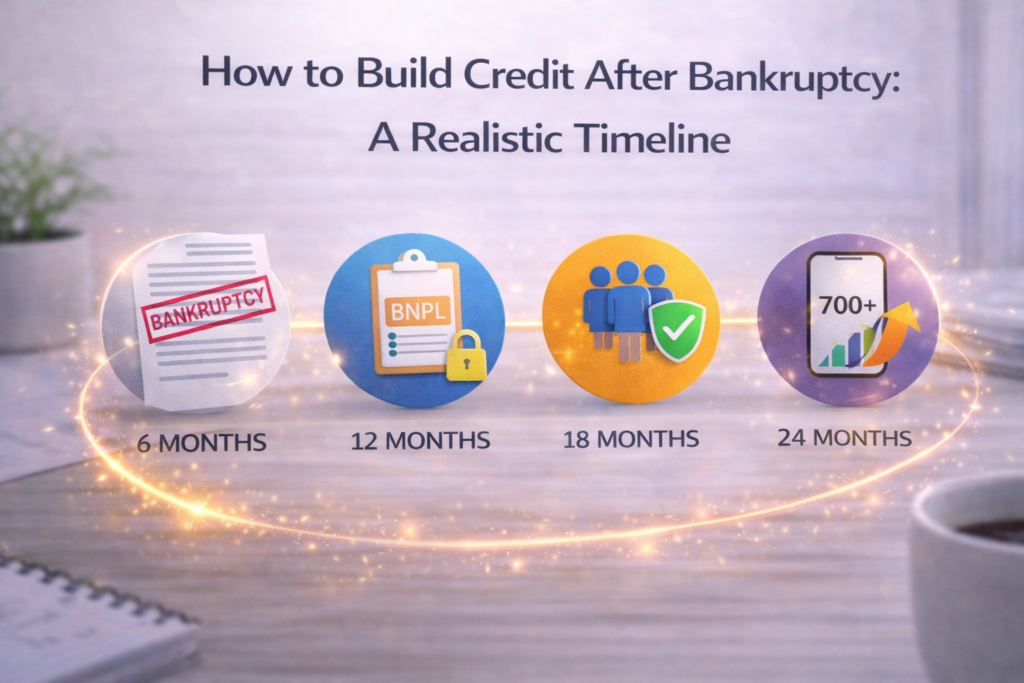
Bankruptcy is one of the most significant negative events that can appear on a credit report. It signals to lenders that your debts became unmanageable to the point where legal discharge was necessary. The credit damage is real and it is serious. But it is not permanent, and the path back is clearer than most people in this situation are led to believe. Here is an honest, realistic timeline for rebuilding credit after bankruptcy and what to focus on at each stage. First: understand what you are dealing with There are two main types of consumer bankruptcy and their credit implications differ. Chapter 7 bankruptcy, which discharges most debts, stays on your credit report for ten years from the filing date. Chapter 13 bankruptcy, which involves a repayment plan, stays on your report for seven years. During the time it appears on your report, a bankruptcy is one of the most significant derogatory marks a lender can see. It will affect your ability to get approved for credit and the rates you are offered. But its impact on your score decreases over time, particularly as you add positive information to your file. The accounts included in the bankruptcy will also appear on your report, marked as discharged or included in bankruptcy. These will fall off your report at seven years from the original delinquency date, which is often before the bankruptcy itself drops off. Months 1 to 6: stabilize and assess The first priority after bankruptcy is not rebuilding credit. It is stabilizing your financial situation so that whatever you build next does not collapse again. Pull all three of your credit reports from annualcreditreport.com and review them carefully. Confirm that the accounts included in the bankruptcy are accurately marked. Errors in how bankruptcy is recorded are not uncommon and any inaccuracies should be disputed immediately. Set a realistic monthly budget. Understand exactly what you can afford to pay on any new credit obligations before you open anything. The worst outcome after bankruptcy is running into the same problems again. If you are renting, this is a good time to enroll in rent reporting through Credit Genius. You are already making that payment and adding it to your credit file starts building positive history immediately without requiring any new debt. Months 6 to 12: open your first new account Once you have stability, it is time to start adding positive credit history. A secured credit card is the most accessible entry point after bankruptcy. Because you provide a cash deposit as collateral, approval is possible even with a bankruptcy on your file. Choose a card with no annual fee that reports to all three credit bureaus. Use it for one small recurring purchase and pay the full balance every month without exception. The goal is a positive payment data point, not spending power. Some lenders offer credit builder loans specifically for people rebuilding after bankruptcy. These work by making monthly payments into a locked savings account, with the payments reported to bureaus. At the end of the term you receive the money back. It adds payment history and a savings habit simultaneously. Year 1 to 2: build momentum By the end of your first year of consistent positive activity, you should have a secured card with twelve months of on-time payments, potentially rent reporting history adding additional positive data, and a credit score that has begun recovering from its post-bankruptcy low. Many people are surprised by how much their score can recover in this period if they are consistent. The scoring models are forward-looking as well as backward-looking. They weight your most recent behavior more heavily than older history, which means consistent positive activity in year one has a real, measurable impact. At the 12-month mark, check whether your secured card issuer offers an upgrade to an unsecured card. Many do after a year of responsible use. An unsecured card with a returned deposit and a credit limit increase is a meaningful sign of progress. Year 2 to 4: expand carefully With two or more years of clean post-bankruptcy history, your score should be in a range where more options become available. You may qualify for unsecured credit cards, better loan rates, and more favorable apartment terms. Expand your credit profile carefully. Adding a second account with a different credit type, for example adding a credit builder loan if you only have cards, or adding a card if you only have installment loans, improves your credit mix without taking on unnecessary risk. Space out new account applications. Every hard inquiry has a small negative impact and every new account lowers your average account age. Open one new account at a time and wait at least six months between applications. Year 4 to 7: approach pre-bankruptcy levels By four to seven years after bankruptcy, many people who have maintained consistent positive behavior have credit scores in the Good range, 670 to 739, and some reach Very Good territory. This is the range where mortgage applications become realistic, better loan rates are available, and the bankruptcy is becoming a progressively smaller part of your overall credit story. The accounts from the bankruptcy are beginning to fall off your report at the seven-year mark. As they disappear, the remaining picture of your credit file becomes increasingly clean. What not to do after bankruptcy Do not apply for multiple accounts immediately. You will face higher rejection rates and multiple hard inquiries compound the damage. Do not pay a credit repair company to remove the bankruptcy. An accurately reported bankruptcy cannot be legally removed before its expiration date. Companies that promise otherwise are not being honest with you. Do not avoid credit entirely. Some people respond to bankruptcy by swearing off credit completely. This is understandable but counterproductive. The only way to rebuild your credit file is to add positive credit activity to it. Avoiding credit means the bankruptcy sits on your report with nothing positive being built around it. The bottom line Rebuilding
How to Build Credit as a College Student With No Income

College is one of the best times to start building credit, even if you have no income. The options available to students are genuinely accessible, the amounts involved are small so the risk is manageable, and every year of credit history you build now is a year you will not have to build later when the stakes are higher. Here is a practical guide to building credit as a student with little to no income. Why starting in college matters Credit scoring rewards account age. The average age of your accounts is a factor in your score, and the oldest account on your file is particularly valuable. A credit account opened at 19 that you manage responsibly throughout college gives you a four-year head start on the peer who waits until 23 to start. When you graduate and start applying for apartments, car loans, or eventually a mortgage, you will be competing with people who have been building credit for years. Starting in college means you can enter that competition already ahead. Become an authorized user on a parent’s account This is the easiest and most immediate credit-building move available to most college students. Ask a parent or family member with good credit and a long-standing account to add you as an authorized user on one of their credit cards. You do not need to use the card or even receive a physical copy. Their payment history on that account can appear on your credit report immediately and give you an instant boost in payment history and account age. If the primary cardholder has a ten-year-old account with perfect payment history, you benefit from that history the moment you are added. This only works if the primary cardholder has a clean record and low utilization. If they have missed payments or carry high balances, the authorized user status can hurt rather than help. Have an honest conversation about their credit habits before asking. Apply for a student credit card Student credit cards are specifically designed for people with limited or no credit history, and many of them do not require income from a job. Some allow you to count financial aid, scholarships, or parental support as income on the application. Start with a card that has no annual fee, a low credit limit, and ideally one that reports to all three major credit bureaus. Use it for one or two small recurring purchases each month, like a streaming subscription or a coffee, and pay the full balance before the due date every single month. The goal is not spending power. The goal is a monthly positive payment data point on your credit file. Report your rent if you live off campus If you are renting an apartment or a room off campus, that monthly payment can be one of your most powerful credit-building tools. Most students who rent off campus make their payment on time every month and receive zero credit recognition for it. Rent reporting services submit that payment history to credit bureaus. Credit Genius reports to Experian and includes backdating, which means if you have been in your apartment for a year you can submit that entire year of history at once rather than starting from zero. For a student with a thin or nonexistent credit file, this can produce meaningful score improvement quickly. Consider a secured credit card If you cannot get approved for a student card and are not eligible for the authorized user option, a secured card is the next best alternative. A secured card requires a cash deposit, typically 200 to 500 dollars, which becomes your credit limit. Because the bank’s risk is covered by your deposit, approval is accessible even with no credit history. Use it the same way you would a student card: small purchases, full balance paid every month, on time without exception. After six to twelve months of consistent activity, many secured card issuers will upgrade you to an unsecured card and return your deposit. Let your student loans work for you If you have federal student loans, they are almost certainly already being reported to the credit bureaus. Once you enter repayment, every on-time monthly payment is adding positive payment history to your file. This does not mean you should take on unnecessary student debt for the credit benefit. It means that if you already have student loans, treat the repayment period as a credit-building opportunity and prioritize on-time payments from day one. What to avoid Opening too many accounts at once. Every application is a hard inquiry. Multiple applications in a short window signals financial stress and lowers your average account age. Pick one or two options and focus on managing them well. Missing payments. A missed payment stays on your credit report for seven years. Set up autopay for the minimum on every account so this never happens accidentally. Carrying high balances. Credit utilization is the second biggest factor in your score. Keeping balances low relative to your limit matters even on a small student card. Closing accounts you no longer use. Old accounts contribute to your credit history length. Even if you stop using a card, leaving it open protects that account age. The bottom line Building credit in college does not require a full-time income or a complicated strategy. It requires opening one or two accessible accounts, making every payment on time, keeping balances low, and being patient. The students who start this process at 18 or 19 graduate with a credit file that opens doors their peers are still trying to unlock. That advantage compounds for the rest of their financial lives.